
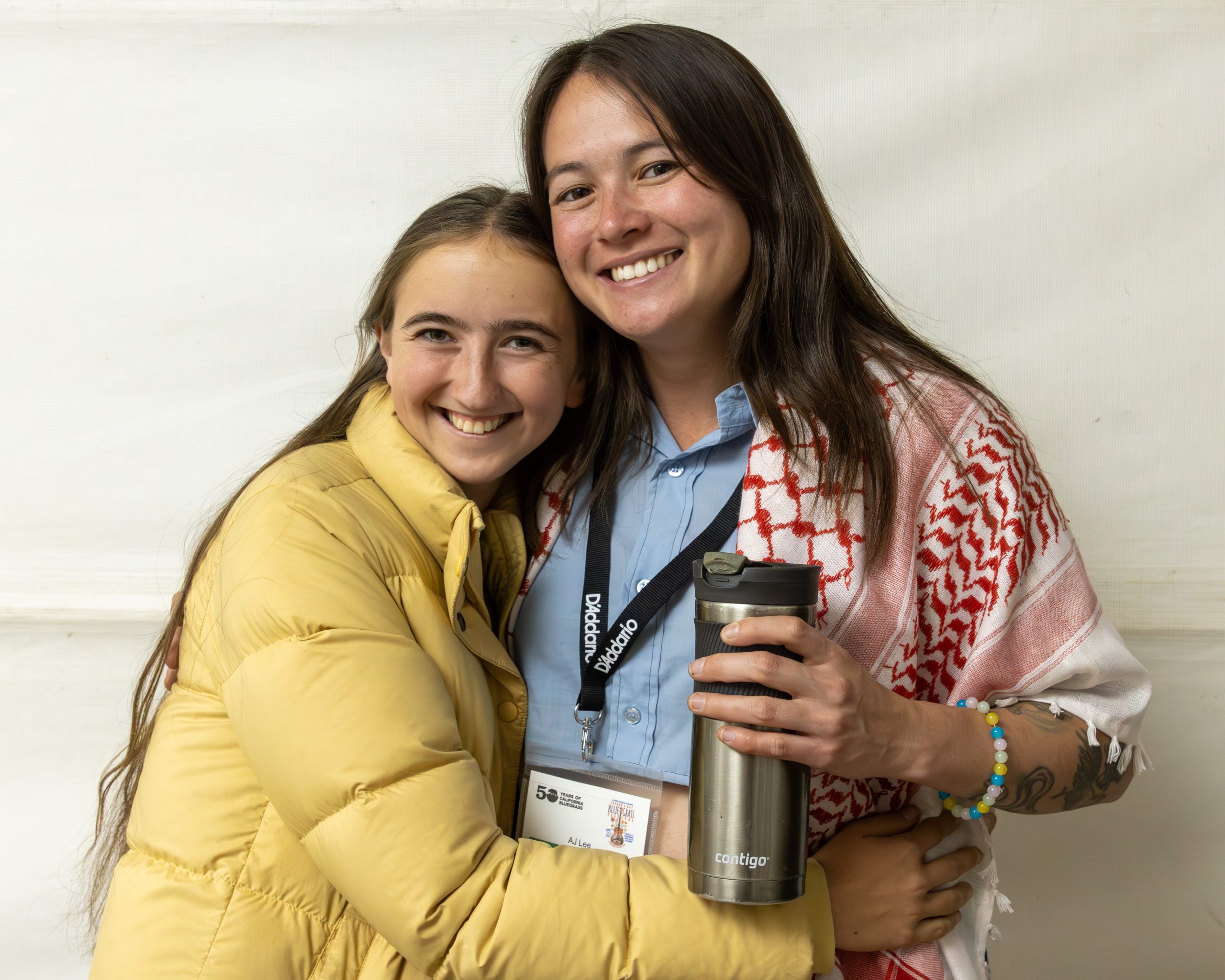
photo by Robin Frenette
In this series, Joselyn explores what it takes to make the leap from campground picker to professional performer. In this seventh installment, we hear from AJ Lee, whose many accolades as a mandolin player, vocalist, songwriter, and bandleader include the IBMA Momentum Vocalist of the Year, nine-time NCBS vocalist of the year, and NCBS mandolin player of the year. She currently tours with her band AJ Lee and Blue Summit, which is making waves as one of the top bluegrass bands of the day.
Joselyn Sky: What do you remember about your first tour?
Aj Lee: I did some tours with The Tuttle’s with AJ Lee, but I wouldn’t really call them tours like I’m doing now with Blue Summit. I can’t exactly remember the first one we did, but I remember back when it was me, Jesse Fichman, Sam, and Isaac. We would do some tours around the South Bay area, Santa Cruz, and Monterey; maybe pop down a little bit on SoCal, but not too much.
It was really casual in the beginning of touring, because it was so new for everyone. We were like, “Oh my god, we’re all in our cars, we’re going to tour together, this is so fun,” so it definitely felt like less of a job per se, and more like a road trip.
What are some things you do differently now, and have learned about touring since then?
There are many, many things that have changed. First of all, everyone actually dresses in stage clothes when we play. We’ve transitioned to, “Oh, this is actually a job, we should look nice.” No khakis, no sneakers …
I’d say mostly just the flow of the shows. The attitude has changed from less casual to more professional.
In hindsight is there something you wish you had known or done differently?
It’s hard to say in hindsight, because even now we’re still getting better. We don’t have it all perfectly down. We’re always oiling the machine to make it better. So I guess in hindsight, I wish I knew what I know now, but that’s one of the best things about touring: you learn along the way and you get to see the process change and what works for you.
It’s all a flow, so I wouldn’t really say I would change anything, but just enjoy the process that’s happening.
What was it like recording your first album and how does it compare to your process now?
We have three albums out, and the first two were self-produced by the band. For the first one, we didn’t go to a studio and track how we track now. Now we go to the studio, but the first album was just like a fun hangout.
We had our friend Parker bring a bunch of stuff, and we set it up in this A-frame, totally not sound-treated Airbnb. We had drums try to play there too, and one whole side of the Airbnb was just all glass pane. Super great for sound (not!). But it felt like an organic thing.
If you’ve seen documentaries, The Beatles would just set up in warehouses or random places. So we did that for the first one, but now we do more studio time … It’s less of a creative feel, but we have our process.
How would you advise a young musician to go about recording their first album?
For me, I’ve learned that when you go in the studio, you have to track with more confidence than you would probably sing on stage. Because there’s a thing that happens sometimes when you’re tracking and you’re in the cans [listening with headphones]. You’re all in your head. Sometimes, I would have a tendency to sing a little more timid and light, because I’m this close to the microphone and I don’t wanna yell into it. I don’t want to play too hard—I don’t want it to clip [distort the recording].
But that’s one of those things that you have to overcome, because the harder you play with more soul, and the more you yell into that microphone, it’s just gonna come across better.
It still happens to me. Every time I go in the studio, I have to think specifically: “Okay, I’m just gonna go for it.” And even when I say I’m gonna go for it, there’s still headroom where I could have gone for it more, every single time.
Do you have any tips for coming up with song and setlist arrangements?
Songwriting arrangements: The way we usually do it is: I’ll present most of a song or a completed song, but usually Scott, Sean, or whoever will be like, “Oh, it’d be cool if we did this little thing here.” The words are pretty much taken care of by whoever’s writing the song, and then the rest of us like to add in little pieces of arrangement to accent the song.
As far as setlist goes, it’s always nice to think of the flow of the entire set … Usually, it depends on the situation, too. If you’re playing at a club venue where it’s kind of rowdy, usually you’ll start super strong. We’ll group three songs together, and we’ll play some quick ones and then taper it down, and then bring it back up.
For festivals, we’ll start with what I call “epic songs,” which is how I would probably describe our song “Hillside,” which is more dramatic, in a way that has lots of movement in the song, and it’s not just right-out-the-gate super fast. So sometimes we’ll start with an epic or dramatic thing for festivals, just to set the mood. It all depends on the situation, but you always want to have a certain flow. You don’t want to just group all the slow songs or all the fast songs together.
How do you navigate staying true to bluegrass roots while still evolving as a musician and creating your own unique sound?
Some of it I try to do consciously, but a lot of the time I can’t really help it, because I grew up in bluegrass. In songwriting, it’s really hard for me to try to write a pop song sometimes, because the brain doesn’t really work that way when you’ve been doing something for so long. But it’s a good exercise to branch outside of that. If you’re only writing country, only writing bluegrass, or only writing pop, whatever. Trying to filter in elements of other things.
For instance, if I’m having a writing session and I want to try and write a bluegrass song—which, first of all, is super hard to write. Everyone knows that bluegrass is hard to write because it has to be so simple, but powerful at the same time. But anyway, if I’m doing writing sessions, sometimes I’ll think of an artist in my head, like Bonnie Raitt or something. I’m gonna write a bluegrass song, but there’s always this thing in the back of my mind, that maybe I can filter in.
In our modern day world, what have you found to be the best way of promoting your music?
These days, bands will do promo videos for a show. I’ve noticed a lot of people tend to shift more towards sitting and playing, and then having text for all of the information. Because even for me, if I’m scrolling, I’ll just read the thing and I got it. So it’s better, in my opinion, to play something interesting—or even b-roll, like you’re walking around doing casual stuff—and then you have this text so people can read and see something interesting at the same time. Of course, paying for ads is good too, but just making interesting content and trying to brainstorm what will captivate people, I think is the best way.
What has your experience been working with managers?
There’s good managers; there’s bad managers. It’s hard to find a good manager sometimes, but we really enjoy working with Jacob. Most of our team that we have—Jacob, our manager, and Chandler, he also toured in a band. Helen, she didn’t really tour, but she’s a musician and she’s been in the bluegrass community forever. So our team collectively, we all have the same mindset.
There’s two different types of managers. There’s the ones that have done it, and have the same mentality. Then there’s the ones that aren’t musicians for whatever reason, but sometimes those people have a lot of resources and can get you the gig that some other managers can’t get you. I prefer people on our team who get it, instead of the ones who don’t.
How do you engage the audience and make them excited about your music, especially if the energy of the room feels low?
You actually have to say on the microphone, “Hey, feel free to clap and make noise, or get up and dance.”
Sometimes—especially if it’s a sit-down audience—you have to give them permission, because otherwise there are different vibes in the audience. Somebody is like, “Oh, I want to make some noise,” and then the person next to them will be like, “SHHH!” That happened a few times at our shows, and sometimes—if we know that’s going to happen—we’ll say to the audience, “Feel free to be loud, because we hate when people shush each other.” It can be different though, depending on the venue, if it’s specifically a listening venue …
I think you have to remember that they’re there to see you. They are having a good time, they just might not show it.
What’s your pre-show routine?
It’s important for all of us to have our solo time before the show to do whatever we want, because you don’t want to just go, go, go throughout the entire day. You need to have a little bit of downtime … Maybe I’ll warm up or sing a little bit, but it’s mostly just about getting into a really composed, chill headspace.
Do you ever get nervous before shows?
I get very anxious, not about the music so much, but the process itself. Because you never know what kind of audience you’re going to get. Sometimes I’ll have a song on the list, and I’ll see the audience before. Then I’m like, “I don’t know if they’re going to like this song,” and I’ll get in my head about it.
The funny thing is, when we played the Opry, I wasn’t really nervous at all. I had maybe 20 minutes of, “Oh shit.” But I think it was because at the Opry, their entire staff was very welcoming. They procured a vibe of, “Oh, this is great that you’re here, I hope you have a great time.” Instead of, “Hey, this is a big deal.”
How do you calm down when you’re nervous?
Well, a shot of whiskey helps … Probably just playing music with the band, because once you feel like you’re warmed up, once you’re confident that you’re not going to mess up as much as you would if you just went on cold, that helps smooth it over a little bit.
What’s the first thing that comes to mind as a piece of advice for someone looking to make a career as a performing musician?
Enjoy the process and never take anything too seriously. Even with professional musicians, you can do silly stuff on stage. You can feel free to banter, be natural, and say things that you usually say just to anybody. That also helps with not being nervous, just feeling like you’re connecting with people. Having the confidence to make mistakes and be silly. When you feel like you are having fun, then that really comes across, and then the audience has fun.
