
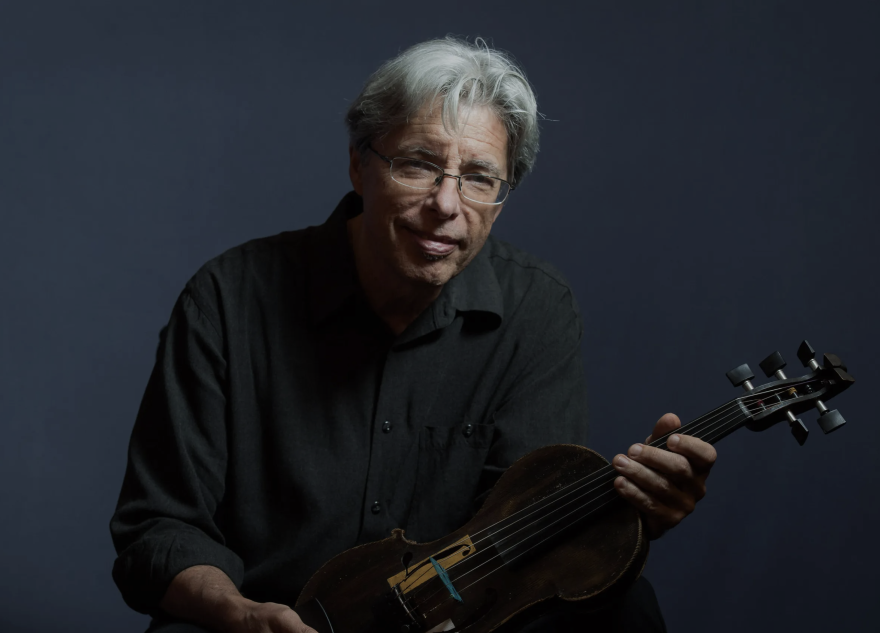
In this series, Joselyn explores what it takes to make the leap from campground picker to professional performer. In this sixth installment, we hear from Darol Anger whose many accolades as a renowned fiddler, composer, producer, and educator include the IBMA Distinguished Achievement Award.
Darol Anger: Just a bit of context for this interview: here’s the general situation.
Diary Of A Fiddler, The Sequel: Empty Nest Syndrome
The first volume of Diary Of A Fiddler was released on Compass Records in 1999 and featured me accompanying a wide range of brilliant contemporary fiddlers in many of the styles which were exploding into popularity at the turn of the new century …
If Diary #1 was an expression of the recent amalgamation of an international multi-stylistic fiddling community, Diary #2 is a celebration of my particular connection to that community and a shared musical ethos within the acoustic string world.
This second volume, due out this year—26 years later—celebrates the brilliance of at least three generations of spectacularly skilled fiddlers with whom I’ve been privileged to work. This phenomenal bloom of talent shows no sign of slowing down and is directly attributable to the ongoing effect of fiddle camps created by Jay Ungar, Alasdair Fraser, Mark O’Connor and others, which sparked Diary #1.
Each of my duet partners in Diary #2 is a former student or someone with whom I have worked at some level of mentorship. I feel a deep connection and admiration for all of the players on this recording, just as with volume 1.
Though I hope to record music for many more years, I consider this project, Diary Of a Fiddler #2, to be the clearest expression of any musical legacy I might leave to society. And if it happens to be the last thing I release, I believe I can consider my work on this Earth complete.
Joselyn Sky: Who were your biggest musical influences when you were starting out, and did you have any mentors that gave you memorable advice?
Darol Anger: I took classical violin lessons in 1966 after failing at the guitar. I’d already started copying Eric Clapton licks on electric guitar by 1968, though. I didn’t even know fiddling existed until 1970, when I saw Richard Greene play with Seatrain, opening for the Youngbloods in my California hometown. I thought that what Richard did was all of fiddling, and then I heard Scott Stoneman! My education gradually widened from there. Byron Berline became a favorite, and then of course Vassar Clements, who made me realize that fiddling could have a deep spiritual component. John Hartford’s Aereo Plain came out and that made the Bluegrass sound a lot more relevant to me. I loved drawing ideas from other instruments, especially mandolin, banjo, and guitar, and later, the usual saxophone geniuses.
But the best and most effective mentors for me have been David Grisman and Tony Rice … David set an indelible example for me not only in the department of self-guided self-education, and always pursuing excellence, but in embracing and enjoying musicians and music. Don’t be intimidated by musicians who appear to be ahead of you in various areas of technique or conception. Go right to them! One of the greatest things David ever said to me was, “Hey man; I’m scared of being scared!” Don’t be scared, life is way too short not to accept the challenge to create … Tony Rice of course, set an example for all of us every time he played. I think Tony probably had the strongest will of just about any musician I’ve ever met, in terms of being able to force the body to do pretty much impossible things.
What do you remember about your first tour, and what have you learned about touring since then?
Our first real DGQ tour, and my first ever tour—amazingly—was to Japan as an opening act to the Muleskinner band, with Dawg, Richard Greene, Bill Keith, and Todd Phillips playing bass. It’s probably the best place we could have gone really, because the audience was completely open. Bluegrass was an exotic foreign thing to them. We were also playing this original music, Dawg music, that wasn’t really any more exotic than the bluegrass was to those folks … The idea that we were taking this brand-new music to a place that none of us had ever been—brand new music, brand new place—was so exciting. It was also amazing because initially David said, “Well, I’m not going to do this Muleskinner tour unless I can bring my band.” That’s just another of many examples of David’s integrated focus on his career, combined synergistically with loyalty to his band members and whoever he was working with. One of the most loyal leaders I’ve ever worked with …
It’s harder to start touring on your own because it’s expensive, and if you don’t have any history in a new place, it can be depressing. Make sure you have a recording out and so forth. Start in your town, then try other gigs in the county, then start making forays in your region, and work out slowly. The goal is to make friends along the way, and it gets easier.
My solution, which has worked for many, was to get in another person’s band, do whatever it takes to make the leader’s job easier, keep your eyes and ears open and make friends!
How do you engage the audience and make them excited about your music, especially when the energy of the room feels low?
I think that sharing truth is a great tool to connect with other people in general. You sort of have to start with where the room is, and gradually persuade people to go with you. If everyone’s psyched to be there, then it’s easy—you just let the folks know you’re as psyched as they are, and go with that. A show is an interaction between the people on both sides of the stage, and some talking, some acknowledgment of the vibe, if everyone seems tired or disconnected. It’s good to just play the “adult” in the room and start there, let people know you’re with them, and maybe start with some easy, quieter material with some emotional content and bring the energy up slowly. If everyone’s just gabbing and not interested in the band, engaging the audience by asking some questions “How many of you are (fill in the blank) … here for the beer, here for the band, here for your buddies, like fishing (here’s a song about fishing), just broke up, (here’s a song about a breakup) etc., might be a good start.
Can you identify any particular things that you believe contributed to the success of your career?
I was in the right place at the right time for the kind of music I was into.
I tried to prepare as much as I could. In fact, by the time Todd Phillips got me up to David Grisman’s place to jam, I had already recorded one of his previous band’s shows, and learned all the tunes from their set, and all the melodies, chord progressions, made up some harmonies, and learned most of Richard Greene’s improvised solos from each tune. Of course, I wasn’t the player that Richard Greene was, but I really knew the material and was a worker. I tried to improve each time I played. Also, trying to learn as much about not only music, but everything else that music connects with, which is everything. And listen to anyone who will share information with you. Make friends. Be friendly. That kind of thing.
What was it like recording your first album, and how does it compare to your process now?
So different! But the things that are the same are:
- Have a budget and funding in place.
- Know the material you’re going to record.
- It’s supposed to sound like you had fun.
How would you advise a young musician to go about recording their first album?
Get with someone who has done the process at least twice before, and let them produce it. But start, all the while consulting with this trusted person, with a clear idea of what you want to present and a clear budget. Then pay close attention to everything that is going on. Ask all the questions you can get away with.
You have a lot of leeway for your first recording in that you can get away with doing a lot of things: “This Is The Many Moods Of Me.” After that, it’s better to focus on some general theme for each release.
Do you have any tips for coming up with song and/or setlist arrangements?
Look for a storyline, some kind of flow so that the song or setlist can feel like a complete experience. Just like in a song, the emotional hit comes about 3/4 of the way from the end. You can learn a lot from good movie synopses about pacing, story, etc. A song needs to get your attention at the beginning and take you somewhere. Sometimes it can just plop you down somewhere good and let you cook in those juices, too.
Set lists need the same thing; they’re just larger songs. You need flash, warmth, some real emotion, humor … how does this set of songs fit together?
Flash first, with lots of feel-good and humor is a great way to start, then something groovy but not too long—then slow it way down, build from there to your most meaty/ambitious thing about halfway through. Something light and funny after that, more flash, and save your warmest, most feeling-driven thing for about second to last. Then something positive with a great groove and hook to finish up. You can go against the rules if you know what they are.
What’s the first thing that comes to mind as a piece of advice for someone looking to make a career as a performing musician?
Get to a place where the musicians are. Preferably musicians your age and a little older. That generally has meant a college town like Boulder, Boston, Nashville, Chicago, Asheville, L.A., Oakland, Seattle, wherever. You’ve got to be where stuff is going on. I know plenty of great musicians who never went to school for music but moved to a place like Boston, taught themselves, learned from others, and wound up in bands or leading bands with their peers who were looking to do the same thing, many of whom did actually spend quality time in school.
Being an artist of any kind, but especially performing arts, is a very bilateral thing— you have to be an introvert in order to create anything original, but also be good at extroversion, too, in order to share and develop it. I started out very introverted and had to develop my extrovert side. Luckily, I had a good model for that: my mother, who could throw a great party for 200 of her closest friends, while I was perfectly happy reading or practicing the violin or guitar in my bedroom, enjoying the sound of that carousing and good fellowship downstairs. You might go the other way. It’s important to be good with long periods of silence and solitude in order to figure out not only the bridge to that tune, but also to figure out yourself.
I went to where the musicians were to teach, both in and out of a school (Berklee), and look where that got me!
