
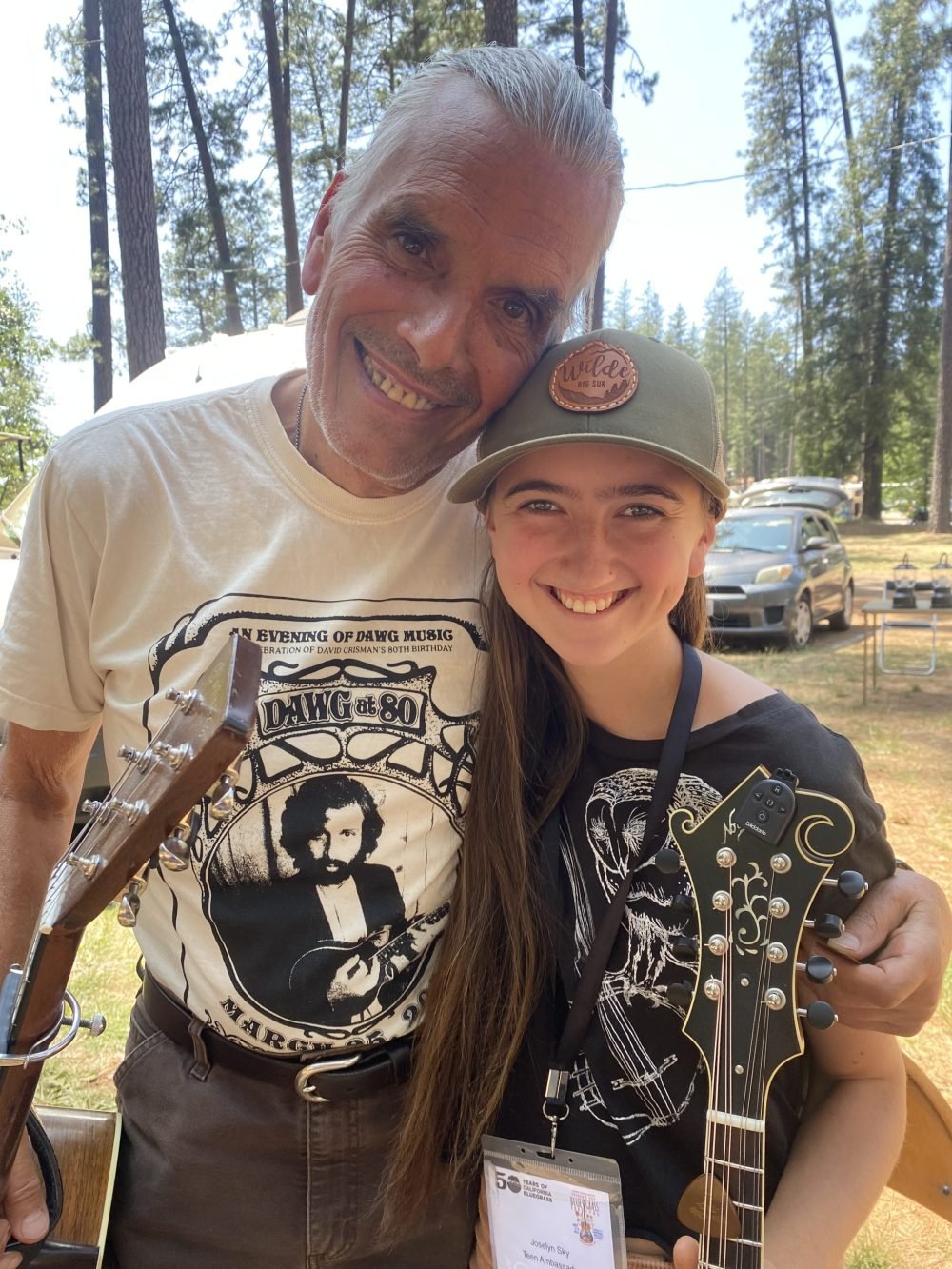
In this series, Joselyn explores what it takes to make the leap from campground picker to professional performer. In this eighth installment, we hear from Keith Little, whose many accolades as a multi-instrumental performing and recording artist, composer and producer—and a CBA charter member and honorary lifetime member. Keith has performed as a side musician on nearly 100 albums, including singing harmony on two Dolly Parton records.
Joselyn Sky: Who were your biggest musical influences when you were starting out? And did you have any mentors that gave you memorable advice?
Keith Little: Yes, many … My father was the third boy in six children. He was a very important influence upon me because he loved to play guitar and sing. He was a self-made kind of guy. Deep in his core, he realized that there was really nothing that he couldn’t do if he only applied himself. I got that from him. I also got the unabashed joy in making a sound.
Now, let me talk a little bit about my mother, too, because she was equally important. She was the youngest of eight and she was raised by her mother … She had this deep appreciation of the arts and a reverence for teaching. She somehow instilled in me that the arts were worth pursuing, and if I wanted to do that, she was behind me.
In 1967, we moved to El Dorado County. My father was a forest ranger and he was in charge of this facility that had a bunch of inmates that were used as a fire crew. He went on this fire to Southern California. On the way back—it was a really brutal fire; they’d been there for a couple of weeks and everyone was hot and tired and they hadn’t taken a shower—he pulled into a motel, and they all got a room and cleaned up. He thought, “Okay, what are we gonna do?” So he took them all to the movies. They saw Bonnie and Clyde, this movie that had the original 1950 version of “Foggy Mountain Breakdown” in the soundtrack. So he’s there watching this movie with these inmates and he just freaks out.
When he got home, he bought the Pete Seeger book … and, because in the Pete Seeger book it said if you’re going to learn to play this music, you’ve got to be able to hear it. At that point he conscripted me and he said “Look, would you help me? I want to get a record player. Would you help set it up?” And I said, “Sure.”
So we went to Auburn, California, and ordered three albums. Foggy Mountain Banjo, with Flatt and Scruggs, and the Mountain Song Favorites with the Stanley Brothers, and Country Music Time with Bill Monroe.
I must have been 11 or 12. I remember setting it all up, and when the needle went down on the first cut of Foggy Mountain Banjo, a song called “Ground Speed.” I remember what I was wearing, what the room looked like, and everything about that moment.
So my father learned to play the five-string banjo … We learned with him because we could hear him practicing. When he got pretty good at “Home Sweet Home,” I entered him in a talent show at the grade school where I was going to school, and I backed him up on guitar. That was his one and only public performance. When we got home, he said, “Hey, you ought to try this banjo. It’s really fun.” I had never really considered playing the banjo. From that moment, he never got it back.
I would get up early before my parents, and I would play, and then I’d go to school, and when I got back from school, I’d play.
I had figured out how to stuff a towel in the back of the banjo, and I put clothespins on the bridge, and I had a set of headphones so I could play way into the night. I was making no noise, but I was playing along with these records that I was trying to learn. I remember my mother, one time, she took the headphones off and she let them go and they snapped against my ears. She just said, “Go to bed. Now.” I didn’t realize it was midnight.
For young people, it’s important to know that you can do whatever you want to do. If you want to be a professional musician, you can set out to be one. The other thing is to have a reverence for the art form. I was so lucky when I was young. I was raised 10 miles from this guy named Ray Park. He and Vern Williams were like the Flatt and Scruggs of California, and they were so fabulous.
I was at the high school in my freshman year … I was carrying my banjo across the parking lot, and there was a Chevy van that came in the empty parking lot. It was after football practice, so the two of us were walking to my friend’s car. My friend was a year older than me, a sophomore. The van came screeching to a stop, and this guy rolled down the window and he just said, “How many strings does that banjo have on it?” I said, “Well, it has five.” He said, “Do you pick it?” And he put his fingers out the window like this [making a banjo rolling pattern with his hand]. I said, “Yeah, I do. I play it like that.” Then this buddy of mine said, “He’s really good.” It was Ray Park.
I played him a tune in the parking lot. I can’t remember what I played him, but he said, “I’m really happy to meet you. My name is Ray Park. Perhaps you’ve heard of me, I play with this guy named Vern Williams. We have a band called Vern and Ray.” I said, “Oh! I know who you are!” I had the Starday compilation that had “Cabin on a Mountain,” “Bluegrass Style,” and a couple of others. It was like meeting Moses, or something! He said, “Here’s my phone number. Give me a call and come over any time you want.” So quite soon after that, I got my mother to drive me to Placerville, and I stayed with Ray for the weekend. He was so sweet.
Both Vern and Ray had sons that were my age—Ray’s son was named Larry, and Vern’s son was named Del. So Del and Larry and I formed a little kids band. We used to open for Vern and Ray. One time we opened for them at the Freight & Salvage. That’s the first time I remember really hearing them sing. It was so magical. I just thought, “Holy cow! Right there. That’s what I want to do.” It was so transportive in its emotional content, even though I had no idea how to do it, that was what I wanted to do.
What was it like recording your first album, and how would you advise a young musician to go about recording their first album?
When you make your own records, you want to make something that sounds good to you in 10 years.
The first solo recording I made was in 1992, and I had written some songs and I thought I wanted to play them and record them, so I did. When the whole project was done and after we were mixing, I let about a couple of weeks go by. It took two years to record this thing. Finally, I thought, “Wow, the lead singer is not carrying the ball.” And that was me! … In the end I realized I didn’t have the tonal capacity yet to sing my own stuff, and I’d been a professional singer by this time for how many years? … I could match other people’s tone singing in the studio, but I didn’t know what my own voice sounded like.
I was really inspired by a colleague named Jim Wood. He’s a good fiddler, and he said, “Well, find something you like in your tone. You have to listen to the whole thing all the way through.” So I did. I would sing these songs, and I’d listen to them. I would find something that I liked in my tone. But listening to it was so brutal, because most of the time I didn’t like what I heard. So, find something in your tone that you like, and then build it out from there. That’s how, when I recorded my first solo record in 1999, I decided to record not only songs I’d written, but songs that meant something to me. That recording, I can listen to today, and it still sounds good.
Vern knew intrinsically what it meant to be an artist. He couldn’t really explain it all that well, but he did manage to convey that to us, to his son and I. What he said was: “You have to know the canon of music. You have to know where the music came from, and it has to be part of your inner being. But yet, when you play it, you have to hear your own version of it going on.” So it was important to listen to the repertory, but also then to listen to it and concentrate on “Okay, how would I play this song? How do I feel about this song?”
Vern never once told me what to play or how to play, not one time, but he would tell me what he liked … So, over the course of eight years of playing every weekend, I played pretty much the way the guy wanted me to play. But it came from my own well of experience, so it was authentic for me and for him … He got as much fun out of playing around the kitchen table with his kids as he did playing on stage. Another thing he said that I’ve remembered about performing: He said, “Not everyone who comes to hear us is going to like us.” But, if we enjoy what we’re doing and we’re not afraid to communicate that, we’ll drag them along with us into the fun zone—I’m paraphrasing now, but he said we’ll have the opportunity to influence their opinion of music.
Later on I met Rose Maddox in 1980, and the Vern Williams Band backed her up at a festival in San Francisco. She was very influential, too. She said there’s no secret to being an artist. She said all you have to do is be yourself and not be afraid to let it show.
In hindsight, is there something you wish you had known or like done differently during your career?
I wish that I had someone like me now to say, “Okay, record your own voice earlier and get used to what it sounds like.”
When I started with Ricky Skaggs, I got the gig right around New Year’s Day of 1990 … I said, “Look. I want to study with someone who knows singing. Can you recommend someone?” And he said, “Yes, there’s this guy named Gerald Arthur. He really helped Cheryl and Sharon [White]—especially Sharon. So, he gave me his number …
[Gerald] gave me a lot of suggestions of what to do and what to listen for and what to let go of in my own tone. At the end of the session … he asked me, “Why? Why are you singing? Why are you doing this? Do you write your own material? I said, “Yeah, I do.” He said, “Okay, next time you come, I want you to sing one of your own songs for me.” And he said, “I will only take you on in the future under one condition.” I said, “What’s that?” He said, “That you agree to be an artist.”
In my last session with him, I sang “Where Dear Friends Will Never Part.” It’s one of the songs that I wrote, and it was really difficult for me to sing for a long time … He had really good suggestions. But I wish I had studied with someone like him at an earlier age. That’s my regret.
What’s the first thing that comes to mind as a piece of advice for someone looking to make a career as a performing musician?
The first piece of advice I would give to a young person these days is to explore why you’re doing what you’re doing. In other words, get some kind of grounded base that you can come from, and that will carry you …
Most young people these days have such facility and such skill. But their music is sterile to me; it doesn’t have the feel behind it. That can only be achieved by some kind of life experience. So, don’t be afraid to go get a life experience; in other words, don’t have your life be so safe that you never take those kinds of chances. And, realize that love of the music will carry you a long, long way.
When I was in junior college, the last year I took English 1B. It was composition and literature … The first day of class in literature, she passed out three pages, and they had, single-spaced on both sides, nothing but book titles. I bet there were 300 book titles on this. We were supposed to mark the books that we had read. I remember I marked three books: Ordeal by Hunger, Two Years Before the Mast, by Richard Henry Dana, and Animal Farm. I’d read these three books. Not too long after the first day of class—it might have been a week or two later—she called us each in for a teacher-student conference. I got in there and we had a few pleasantries, and I sat down. She thumbed through all three pages, and her comment was: “Young man, what have you done with your life?” “Well,” I said, “I can name to you, in chronological order, every fiddle player that played with the Stanley Brothers from the time they started in 1938 until the time Carter died in 1966,” and instead of saying, “Who were the Stanley Brothers?”—I’m sure she’d never heard of the Stanley Brothers—she just said, “Oh, you’re a musician.” And I said, “Yeah, I’m a musician.” Then, she was able to ask, “What do you play?” I said, “I play the five-string banjo, and guitar, and I am learning to play the fiddle.” She was really smart; here was where she stuck the knife in and made it stick. She said, “Have you started composing yet?” I said, “Not really.” She said, “Ah! You can’t write if you don’t read.” So, she came up with this whole curriculum for me. I took literature twice from her, and then I took composition later… Now I really appreciate that so much. After I took her composition class, and she gave me a B+, she said, “I have to tell you, you’re an A student. But you have to learn how to spell. Your spelling is so terrible.” But anyway, that summer I wrote my first song.
There are times this is going to happen to you: You’re going to be going along, and you’ll think, “Geez, what am I doing this for?” This is the toughest way in the world to make money … I’d just recorded with Dolly Parton, and I’d recorded my solo record. Robert Bowlin played on it, actually. He had a violin shop, and he was working on one of my bows, so he had his visors on. He hadn’t said anything for a long time, and so I’m sort of free-associating, griping about my situation, and I said, “I don’t know, Robert, maybe I should sell shoes or insurance or something.” He just lifted up his visor—and he had this deep voice—and said, “Well, why don’t you just do what God made you to do, and be happy about it?” I wrote that down and put it on my refrigerator.
