
by Jason Dilg, Bluegrass Breakdown Managing Editor
Cover Photo by Alan M. Bond
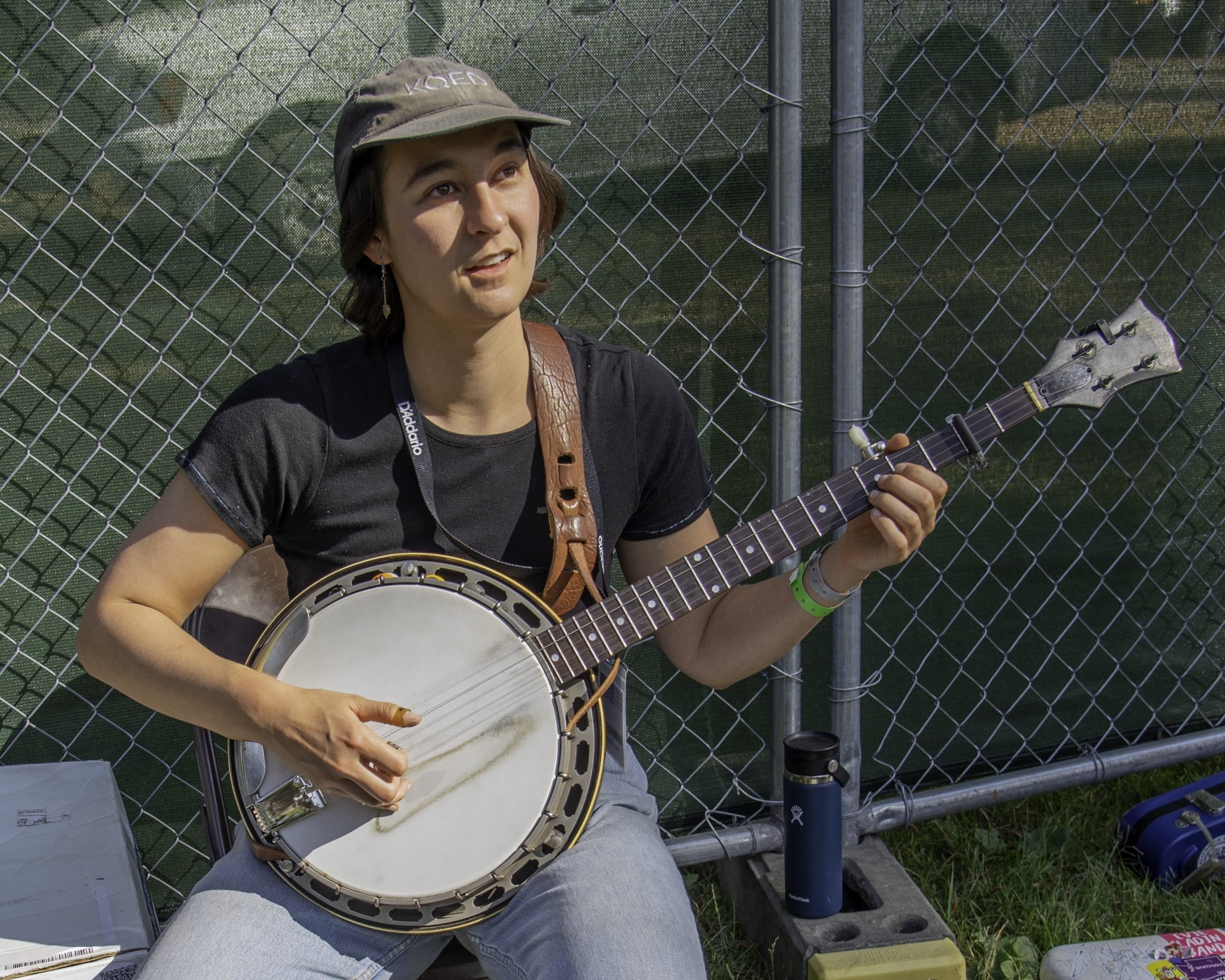
Christine Wilhoyte is a Northern California based singer, clawhammer and three-finger banjo picker, and guitar player. She teaches music and is a familiar performer and instructor at CBA events. We spoke about her musical pathway, current projects, and reflections on bluegrass community.
Jason Dilg: What instruments do you play? What do you like best about your instruments?
Christine Wilhoyte: My Sigma guitar: Easy! The low E string is a total monster, and I heard it from the day I got it, and that’s why I bought it. It’s a relatively medium-quiet guitar otherwise, it’s humble, not loud like a Collings or an old Martin, but it has a nice tone, and that E string just slams and rings and rings. I bought it at Fanny’s Music, a great women-owned music store in Nashville.
Banjo: Which one? The one I play most often is a 1949 Gibson RB-100 (I think) with a Sloan tone ring (I think—banjo nerds, please don’t come asking me questions, I have no further answers for you). Again, humble comes to mind: It’s not a loud or over-the-top, crackly banjo, and it isn’t going to dominate a jam in a round of nice banjos, but it has this beautiful tone to it. You can crack it and it will respond, but it will also play something resonant and kind; it doesn’t have just one mode. I really appreciate that it has that versatility. It sounds so great in double C or open F tuning and yet also totally rocking capo 4 in B. Shout-out to Tyler Stegall for helping me find it!
What music has got your ear lately?
I’ve put quite a few hours in recently listening to The Onlies’ new album. Also, some of the old Hot Rize.
What repertoire are you most excited about developing? What about it draws you in?
My recent project of interest has been honing deeper skill and precision with my rhythm guitar playing. I feel rhythm is the heartbeat of the music and in jams I often don’t feel as confident as I’d like to holding it down. I also want other people who I’m playing with to instantly feel like they can connect to the music and interact with it, and I believe you need solid rhythm for that. Same with jamming with other folks and being able to support them taking breaks—it feels so much better, infinitely different, to take a break over a groove that feels supportive. I’d like to feel solid in this way to be able to make good music myself, but also because I can instantly share the music with others. There’s a certain thing about playing with someone who has that feeling of the music so deep in their bones when they play; it’s really special.
Tell me about your current musical projects—what’s most engaging about them?
My main bluegrass-related projects today are Jesse Appelman’s West Coast Stringband Project and B*Craft, with some occasional side gigs with other folks. I’ve just begun working on a solo project that I’m hoping to get into the world in the next year or so. I’ve also called a couple more square dances this year and surely hope to do more of that.
Something I feel very grateful for with all of these projects is how they each complement each other and engage my musicianship and music-related skills differently. I get to engage with more traditional bluegrass in some settings, and with more original music in others, all with steady musicianship and really satisfying singing. With these different combinations, I feel like I stay really present with each thing as it happens, whether it’s a practice, gig, or hang, because I always feel excited to go to a gig. It doesn’t feel repetitive; it feels fresh and exciting.
I could say a lot about each of these projects, but I’ve found that the crux of what feels engaging is the way they all allow me to get together with other folks in community for the sake of sharing music that’s connective in some way, all while also giving me the opportunity to deepen my musicianship. Jesse writes impeccably beautiful tunes, and Yoseff writes songs that feel just like home to me. With B*Craft, we’ve leaned less into performing and more into creative collaboration, and the singing is just so fun. With square dances, I get to physically watch the level of joy and connectivity in a room increase to what seems like an exponential level. In all these cases, in the deepest sense, it’s healing and it’s honest, and in a more casual sense, it’s just a beautiful part of human nature.
Not to mention that every single person in these musical projects is someone who I really admire and have learned a lot from as a person. Although I don’t play consistently with them, I also want to mention Laurie Lewis and Kathy Kallick as two people who I really admire and have had the chance to play more with recently. I’ve learned a lot about music and about being a person from playing with them.

I feel really happy that music has evolved in this way for me and hope to always center my participation in music around that feeling of connectivity. Especially in this world, we can always do well to cut past our minds and our ideas of division and into a square dance holding hands! Ha.
It seems like musical collaboration comes naturally to you, judging by the numerous projects you’ve been involved in. What are you most excited about when getting a new musical project rolling?
I think music is collaboration. There’s a part that feels really fun about the period of time when a project is going from seed to sapling to tree. When a seed is underground, it could really be anything, you don’t know yet what kind of fruit might come. It’s similar with collaborations: when it first starts, you know you’re planting a seed, but nobody knows exactly what it’s gonna turn into, or how the fruit is going to taste or look, what color it might be. You could have an idea of how you want to shape it and grow it, but you just don’t really know until it’s in front of you. I imagine it’s like looking at your baby and wondering how they’re gonna look and what their life will be like when they’re older. That’s my favorite part—the whole process of nurturing something in that way, and being surprised by and getting to see what comes out of it. And then there’s even a bonus when you bring it into the world, getting to see other people experience it and what their reactions are.
Was coming from a musical family an accelerator or obstacle to your musicianship?
My family wasn’t always musical. A lot of people assume I grew up doing Kids on Bluegrass, but I only really did it a couple times as a teenager. I started playing bluegrass when I was 14 or 15. I think my mom and dad took my sister and I to one Grass Valley when I was pretty young, but I didn’t go back for a long time. Once I did go back, I wanted to learn right away, and my dad taught me “Wildwood Flower.” I think it was all good timing. Pretty soon he had helped me get a Blueridge guitar, and I was in. Having a dad and stepmom who are so steeped in the community already has been an overwhelmingly positive thing, absolutely. They were both generous in sharing their musical—and social—knowledge with me, and that supported me a lot as a new musician, and still does. On top of that, even though there have been some times where I feel overwhelmed by all the people that know me because of my dad, I’ve also been surrounded by an extensive network of supportive people as a result of my dad and stepmom’s presence in the community, and that’s pretty amazing.
I don’t know if I’d call this an obstacle, but here’s a nuance—in the tremendous support of my dad and stepmom—and mom in a less direct way—there were lessons about bluegrass music and the surrounding community that were generously given to me, whereas a lot of other folks whose parents are not musical would have had to gain those lessons through lived experience: anything from jam etiquette, to ideas about what bluegrass truly is, and what makes good bluegrass. In all ways, sharing music with family gave me a huge advantage, and I accepted it readily. And, as with anything that our parents do that gets passed down to us, we go through some period of wrestling with what we inherited to decide what we do and don’t identify with. I’m definitely still in this process of self-discovery and refining my own relationship to music, and specifically bluegrass music and the community. At times, not too long ago, I thought I wanted to sell all my bluegrass instruments! I’m glad I didn’t.
Talk to me about your involvement in the California bluegrass community as a force in your musical development.
The California bluegrass community was absolutely, unquestionably, crucially supportive in my development as a musician. Seeing a community of people connected through music, outside with trees, sharing laughter and food, and sometimes a game of ultimate frisbee—I couldn’t imagine anything better. To witness that it’s even a real way of living and to get to participate completely changed my life and carried me through a lot of trouble. It continues to be a driving force in my musical development—through collaborations with others in the community, but also through the inspiration to share this part of the world with other people and to help anyone see that they can participate, too.
How has mentorship—giving and receiving—played a role in your development as a musician? Has that affected your life in other ways?
Haha! Do you want me to write you a story that never ends? That’s what I think about the benefit of mentorship. There’s this line in “The Riddle Song” that Doc Watson sings, a favorite of mine. The song is a riddle: in the first verse, it says, “I told my love a story that had no end.” The middle verse asks, “How can you tell a story that has no end?” The final verse replies, “when I say I love you, it has no end.”
Before I first moved to Nashville, Sharon Gilchrist let me hang out in her house for a couple weeks after I landed there on my bicycle trip from California. I remember her explaining to me how music is a miracle—she said something like, “How can it be possible that someone makes sounds, and we understand how they’re feeling, with no language attached? It’s miraculous.” This completely changed my life; I never looked at music the same, and it helped me break through all the fear I was feeling about listening to that innocent and yearning piece of myself to make a decision that felt big. I retell this story often. Where would we be without others to teach us and guide us? The only thing better than someone grabbing your hand and helping you cross a river is when you can turn around and do the same for someone else.
My dad and stepmom were some of my first musical mentors. Now I’m trying to think of who else I would name, and I almost just want to name everyone I’ve ever met and ever played with: friends, peers, younger ones, older ones, they’ve all taught something. So many adults in the community have supported me deeply. I remember when I was 17 and first went to SPGBMA, and I met Theresa and Johnny Gooding there. I thought I was such a grown-up being in my freshman year of college in Boulder, Colorado, but Theresa wouldn’t accept my payment for the room we shared. I think she said something like, “Pay it forward later.” That’s what this community is about, and what I hope to pass on in the way I participate—in music and otherwise.
In 2021, you set out to ride a bike across the country to raise money for youth physical education. Do I see in a photo from then a banjo strapped to your gear rack for the ride? Was music a part of that journey?
Oh, yes—that’s a Baby Taylor guitar. Honestly, music wasn’t a huge part of that journey in the sense that it wasn’t connected to the mission or anything, but I frankly couldn’t imagine living that long without playing music. I would play at gas stops and in peoples’ houses that I stayed at, and they enjoyed it. I did a few livestreams. Eventually I ended up in Nashville and lived there for a year, so I guess music was the point of the journey after all!
What’s your relationship to music as a profession or industry?
I’m still learning a lot about how to navigate music as a more integral part of my life and as a part of my life that brings in the main portion of my livelihood, since I just intentionally took that step in July 2025. For now, maybe we could say it’s one of acceptance and curiosity.
Also, I guess I try to stay more or less out of relationship with the music profession as an industry and focus more on being in service to music as a way to connect to others and share its many benefits with them. Of course we naturally may have to do certain professional or industry-related activities, but I’ve seen so many amazing musicians fall into the painful trap of choosing between feeding their heart or feeding their body. Playing music professionally can be extremely taxing on the body—long hours traveling, back-to-back tours, etc. In this way I try to be okay with any way that music may end up taking shape in my life, whether it’s full-time or part-time, ultimately just hoping to find a balance that’s healthy and fruitful for my physical body, for my sense of creativity, and for my community.
Do you see teaching music as something you’ll be involved in for a long time? Why or why not?
Oh, I’m sure I’ll be involved in teaching in one way or another for my whole life. As long as there’s someone who asks, I’ll be happy to share. But related to what I said earlier, whether it’s full-time or part-time, I feel open to any. Most of all, I never want anything I do in music to feel like I’m doing it only because I need money. If I continue getting students, I’ll happily teach, but I wouldn’t want to force it in any way out of fear that I’m not making enough—I want my involvement in music to come from a place of generosity. Especially in this day and age, I feel like we often see people “hustling” their business … Some people are really good at it, but I’m not. I’d rather pick up shifts as a substitute teacher or get a job in a garden than excessively advertise myself. So, I imagine my time teaching and playing will fluctuate at different times of my life depending on what else is going on, and I’m sure there will be lots of other stuff in there. For now, I’m getting to teach a lot, and that’s been incredibly fun and rewarding!
###
You can reach Christine for lessons at christinewilhoyte27@gmail.com