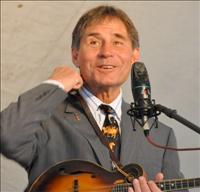
I received my annual notice to renew my membership in IBMA a couple of days ago. I am going to do it—as I have done since the day the organization began. I was there at the first “get together”, and it seems to me now that I will remain a member till the end (mine). I have a low membership number which seems to validate my “history” with the organization. My friend and business partner in the Grey Fox Festival, Mary Tyler Doub, was the first vice-president, and my former wife was the first secretary. For many consecutive years I attended and enjoyed being present at the annual shebang where I could visit with friends and fellow performers, listen to some music, see folks receive their awards, and on occasion present those awards myself. I really like some, but not all, bluegrass music; which I believe is a good thing because it indicates that the music itself has grown and prospered and branched out beyond its original formats and hence has the potential to appeal to many different tastes and preferences. Having performed bluegrass music professionally for 50+ years, it has become an important part of my life; and I have many friends and valued acquaintances in the field. I’ve been involved in the music so long that I have even been privileged (and saddened) to preside over the funerals of a few of its greatest and most noteworthy personalities. And I have lived to witness the passing of almost all its pioneers along with many of its promoters, producers, and “characters.” It would seem that I should welcome the opportunity to re-up my membership in an organization that seems existential to bluegrass music.
But with each passing year, I have more trouble “automatically” re-joining. I’m sure that my disappointments in IBMA are cumulative, but they are real. My reservations have long kept me from attending the annual celebration of the music which IBMA dutifully produces. I have upon occasion given these reservations voice, and I have also tried to do what a responsible individual member can to suggest constructive solutions. By now I am pretty certain that some things simply are not going to change, and in facing the fact that neither am I; I just join out of habit and the certain knowledge that should an opportunity come up to help affect change, I would not want to be there to embrace it.
The word that sums up my disappointment in IBMA is bigotry. I do not mean that IBMA promotes (or ever has promoted) bigotry; rather it is my opinion that no few members have simply either accepted it or learned to tolerate it. There are the good people who put the welfare of the bluegrass industry ahead of their own beliefs, and they are somewhat equally balanced by those who either do not recognize their own bigotry or simply don’t care.
I was raised with bigotry. I learned it at an early age. The nearest town to the little farm that I was partially raised on (in southwest VA—just over the mountain from the Stanleys and the McReynolds’ and the Carters and not far from the musical melting pots that included northwest NC and east TN) had one street that ran through it, Rte. 81. Back in the ‘40s, when I started out as a child, it had a sign on one end of town that said, “Don’t let the sun set on your black back” and one at the other end that said, “If your face is black, be off the street by sundown.” The bank did not close on Lincoln’s birthday (this was before the presidents’ birthdays were all cobbled together in Presidents’ Day). Further I had ingrained in me by family, neighbors, friends, and teachers that “men were superior to women”, that “our religion was superior to all other religions”, and not only was the Caucasian race superior to all other races, folks in our milieu would go out of their way to explain to me the “failings” of other races on an individual-race-basis and in passing possibly mention the failings of the female gender while making sure that I understood both the many ways to make fun of folks who were “different—or ‘lesser’ than ‘we’” while pointing out that I was always supposed to be polite by not mentioning those insulting epithets to the folks that they were designed to denigrate.
It has always struck me as odd that for many years—certainly at least until my late teens (and possibly shamefully beyond)—I never seemed to notice the irony in the fact that the same folks who taught me this stuff were also the ones who taught me “to love one another”, “to think for myself”, “to read and learn”, “to help those less fortunate than myself”, “to have good manners”, “to do unto others…”, and basically “to be a good scout” and follow the “laws” of scouting. (Clearly one of the great ironies of late has been that the Boy Scouts who required the memorization of those “laws”; to wit, to be Trustworthy, Loyal, Helpful, Friendly, Courteous, Kind, Obedient, Cheerful, Thrifty, Brave, Clean, and Reverent have stirred up quite a controversy over their own bigotry by refusing for years to admit gays or accept gays as leaders. I’m not up on this issue—though I was able to remember the “law”, but I think they may finally have relented by recognizing that bigotry clearly violates at least six or seven of their own “laws.”)
This dichotomy is a heavy burden to start out with. I’ve lived long enough now to know that many, maybe almost all, of my generation carried some of this into adulthood with them. And so it was and is our battle (with learned bigotry) to deal with until we die. We all see the ugliness of those who would cling to their learned prejudices. And,yes, I believe that even those who give expression (sometimes proudly to their prejudices) do recognize what they are doing. Most, I believe, even deal with the guilt they feel as a result of their failings to cast these bigoted, learned behaviors off. Most, I also believe, recognize bigotry for what it truly is: hatred.
And so, it is not unexpected that an organization dedicated to the preservation and promotion of a music which was given birth by members of “the greatest generation” in the mountains and hollows of Appalachia might expect to and indeed have members who have to fight that fight against what they were taught as youngsters to become the adults that they “ought” to be and that some may not “want” to be.
With respect to IBMA I just don’t have the patience to endure the bigotry that some seem to be able to conjure up. I admit that with respect to bigotry, I am like a person who has quit smoking that simply cannot tolerate smoking (which I am, as of the past 45 years). I simply resent seeing award presenters make off-hand, disrespectful comments aimed at minorities such as has happened all too frequently at IBMA events. I do not like it when as an organization we tend to act in ways which imply some kind of superiority over others as the time when, for some unexplained reason, we forgot that we were an international (the first word in our name) organization and trumpeted our own nationalism. And I do not like it when we treat each other in disrespectful ways simply because we do not agree with one another, which happened in force just this past year.
To wit: There was an incident where a director referred to our Executive Director with a profane, insulting epithet. This was something that doubtless could have been ameliorated by an apology. But it grew way out of hand. For my own part in addressing the issue I became the brunt of many insulting epithets myself. A person who I considered a life-long friend actually told me that I “had no moral compass” since I wouldn’t put the welfare of the organization before the well-being of an individual member. Another person, whom I did not even know except for his/her name, wrote me constant emails explaining my psychological-profile failings. A person that I had worked with for many years justified the insult to our Ex. Dir. as being “only in regard” to a particular perceived short coming of the woman herself. These rather extreme responses literally shocked me.
They also effectively convinced me that bigotry was far more prevalent and far more insidious in IBMA than I had previously supposed—although my suppositions in these matters had never wanted for strength. In fact, bigotry was part of the substance of my key-note speech to the organization way back in the ‘80s. I believed then and do now that it is our bigotry and not our music which has defined us. Bluegrass music, as Bill himself said, “is a powerful music.” So what is it that keeps our music from being as popular and commercial as other musical forms? I would suggest that we are limited by our prejudices.
Here’s an example of my argument, and my intention is to show how we work against ourselves. The GREAT Hazel Dickens is NOT in the IBMA Hall of Honor. She had the classic pedigree: pure hillbilly from the coal country of WV, started out performing in the rough bars of Baltimore, had a voice recognizable by all who know bluegrass, loved and respected by Monroe himself et al, had award winning recordings, performed with many signal experts in our field, wrote (IBMA) award winning songs as well as songs recorded by artists in other genres, was an outstanding and accredited influence on not only many bluegrass performers but many popular performers of country music and even R ‘n’ R, performed in several movies, carried bluegrass music far beyond its usual boundaries, and was an annual headliner at the largest festival in the country right up to her death. But even with that resume she couldn’t garner the votes for the IBMA Hall of Honor even though it far surpasses the resumes of many of its occupants. She obviously had a disadvantage that could not be overcome: She was a woman.
And not just any woman. She had dignity beyond belief. She carried herself with honor in the manner of the legendary males that literally “invented” bluegrass music. And she had courage beyond reason. If anyone, not necessarily limited to an IBMA board member, had called her a %#^*?<! idiot, she would have done the same thing I would do: punch ‘em out. I guess it’s just the hillbilly way. Even when we’re taught that kind of bigotry, we eventually learn that it’s wrong.
I have actually been told by women who are members of IBMA as justification for some of the untoward comments that get thrown around that we’re “…mostly a membership of conservatives.” Well, I’ve been a conservative all my life. In fact, I believe that in order to be one, you have to be able and willing to actually conserve something; like, say, a budget surplus or a public education system that doesn’t rank with in the mid-range of those of third-world countries. And I don’t believe for one second that crassness, bigotry, hatred, or bad manners are conservative values. Nor liberal ones either. In fact, I don’t believe they’re values at all. And I believe that we should not and cannot accept them as tolerable professional behaviors in our professional organization.
My father who was a union organizer, president, and negotiator at a national level once told me that “Striking is the worst thing that can happen with regards to union activities.” He believed that once there’s a strike, the workers lose all of their leverage. It’s an argumentative premise, but it is true that all that happens after a strike, whatever it is, happens without input from the workers.
I’m joining IBMA again this year. I want to be there when it finds itself and as it progresses towards realizing and becoming what it can be in all the best ways that the music itself deserves. I am hopeful and optimistic that I may live to see IBMA with members of all races, genders, religions, and political leanings just as professional organizations which represent and include other more popular and more commercial forms of music have. I believe that when (and if) that happens, the term less popular will not apply to Bluegrass Music. And I believe that including everyone (as our international nomenclature implies) will make us all better, not only as a result of what we bluegrassers can learn from others but also from what we have to teach and share. Emmylou Harris recently told Dan Rather that she knows people who are full-on, died-in-the-wool atheists who love to perform bluegrass gospel. She went on, “There’s just something that’s ‘spiritual’ about it.” I believe she has nicely described what is best about our music, both secular and gospel. And I believe that our professional organization may just come around to embracing that spirituality to a point where we refuse to tolerate bigotry. So join me as I join IBMA, and let’s truly…love one another.
Ron Thomason, Dec. 2015