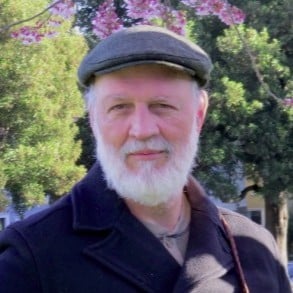
This is a re-post of an interview that previously appeared in the CBA Breakdown.
Bill Foss
Bill is a native San Franciscan who, like many who grew up in the city, got the bluegrass bug from the scene at Paul’s Saloon. He’s played many styles in many bands but is best known in bluegrass circles for his spot-on Monroe technique that dazzles those lucky to experience it.
DB: Most pickers have a geographical or family connection to traditional music. Tell us how you first got hooked?
BF: In 1975 or thereabouts, I’d heard some bluegrass records. My father had some Dillards records and I liked them. I remember going to a place in the Inner Sunset called the Owl and Monkey Café and heard Larry Lyons on banjo and Gene Mitchell on guitar playing bluegrass standards like Salty Dog Blues and I Wonder Where You Are Tonight. It was the first time I’d heard live bluegrass and it just knocked me out. I was hooked. Hearing it live, it just clicked and I thought, ‘I gotta try to do this.’
DB: Are those guys still around and playing?
BF: Larry Lyons is. I see him around and on social media. Gene had a small guitar shop at 9th and Judah that I used to hang out at. I learned a bit of guitar and mandolin from him. He passed away several years ago.
DB: What all instruments do you play?
BF: I’ve played bass, banjo, some guitar, mandolin and fiddle. I traded away my banjo in the 70’s because I wanted to play precise melody, not melodic style banjo. The music at Paul’s Saloon got me more into listening to the mandolin. I saw great players like Butch Waller, Tom Bekany and Stan Miller there, which really got me interested.
DB: Is that the same Stan Miller who is a luthier?
BF: Yes, he builds fine instruments out of Washington State. My main mandolin is actually a Miller F model. I believe he played with Laurie Lewis maybe before Grant Street.
DB: What instrument was your initial focus?
BF: Well I was a beginning banjo/mando player, but quickly realized that everyone wants a bass player. I was familiar with stand up bass from the school orchestra at Hoover Middle School. I realized that bass was my ticket to playing with more people. I played my first gigs on bass with High Country initially as a sub then more regular later on. It let me absorb more music and certainly hear more mandolins.
DB: What about fiddle?
BF: I learned fiddle in my mid 40’s. I got dragged to Lark in the Morning music camp, but I didn’t want to go because there was no bluegrass scene there. But there was a lot of old time and I loved the sound of it. There’s something about hearing it live that really clicked with me. I started playing old time on mandolin but couldn’t get that fiddle sound, so I got a fiddle and started learning old time tunes. I never learned bluegrass style on fiddle, as it’s very different from old time. I really got absorbed into it but ultimately had some hearing issues with it – basically it was just too loud for me – so I dropped it and went back to bluegrass mandolin.
DB: Didn’t you play fiddle with some bands?
BF: I played with the Crooked Jades with Jeff Kazor and Lisa Berman, which was a very creative and musically satisfying period for me. Jeff and I were both into the sound somewhere in the middle of bluegrass and old time. J.E. Mainer and the Mountaineers was someone we both listened to independently. He was an old time fiddler out of North Carolina who had a similar combined bluegrass and old time style. At the same time, I do really love and appreciate the traditional old time “scratchy” style of people like Tommy Jarrell who is also from that region.
DB: Tell us about your mandolin development after fiddle.
BF: I was exposed to and interested in roots music like early blues mandolin and jug bands. The Memphis Jug Band, Yank Rachael, and the Dallas String Band who did the Dallas Rag are good examples. I explored this very deeply and got to play with some great local players such as Meredith Axelrod and Keith Cary. Keith is also known for his unique resonator mandolins made out of toilet seats called the Commodium. I also got to play mandolin banjo in Pete Devine’s Jug Band.
?DB: Growing up, was of your family musical??BF: My father played some folk music so we always had a guitar around the house. He sang some Burl Ives songs, which I thought were great. I probably learned my first chords from him. He had large collection of Motown, rock ‘n’ roll, classical, jazz, folk, bluegrass and country so I was exposed to a large variety of genres.?
DB: Your immediate family all play music. Was that something you planned or was it more organic?
BF: My wife Martha Hawthorne, who I play with a lot, is a guitarist and played bass for the Stairwell Sisters for 11 years. She also plays bass with the Earl White String Band whenever the opportunity arises. My children both play music. My older son Alex studied classical piano and his younger brother Danny is a professional sax player.
We never pushed our kids to take lessons; it was more organic – they just wanted to. Music is a big part of my social life, so whenever we had company, it was probably to play music. So they were exposed to it and probably thought this is just what you do when you want to relax and have friends over.
DB: What bluegrass artists did you listen to in the Paul’s Saloon era and now??BF: Well everyone of course talked about Bill Monroe, Ralph Stanley and Jimmy Martin, so I stocked up on those guys and learned from their records. These days I still migrate to the Monroe camp of players like Mike Compton, Frank Wakefield, and Dave McLaughlin from the Johnson Mountain Boys. Paul Williams who played with Jimmy Martin is another one I’ve studied some.
DB: I saw a video of you playing the Bill Monroe tune Evening Prayer Blues in front of your computer. What got you into doing that?
BF: A great mandolin player named Chris Henry started a group on Facebook called the Monroe Mandolin Appreciation Society, where they engage members to submit videos of their favorite Monroe tunes. I’d always loved that tune and decided to contribute it there.?
DB: How do you generally approach a new song or tune?
BF: First I listen to a tune a lot for what I call the “pre-soak” to burn it into my memory. Slowing down a tune really helps me to hear the phrasing, which is what makes each tune distinctive. In the old days, I used a reel-to-reel tape recorder to slow down the tunes to learn the solos, but nowadays there a lot of other options on computers and such. It’s always been by ear for me. I can read music but it’s more work, and paper never captures the details of phrasing or ornamentations like a recording does. Over time I get more confident with the tune and play it in front of friends before performing it live.
DB: How long might that take to learn a tune?
BF: It all depends on the tune; some may only take an hour or so and others I may not be comfortable with after practicing it many years.
DB: You’ve played in a variety of bands. Tell us about some of those.?BF: Let me see if I can recall them chronologically. There was High Country, the Squids, the Crooked Jades, the Earl Brothers, Pete Devine Orchestra, and the Knuckle Knockers with my wife Martha Hawthorne. I’m glad you asked this, as it gives me a chance to mention the Squids, which I played bass for in the late 70’s with some great players such as Robert Earl on banjo, Steve Pottier on guitar, Larry Hughes on mandolin, Gene Tortora on dobro and Pete Allan on fiddle.
DB: You also study and play in non-bluegrass or old time music. Tell us about that.
BF: I have a general interest in roots music going back to the early days when I first heard Gene Mitchell playing with an Italian mandolin player named Matteo Casserino at the Caffe Trieste in North Beach. They’d also play at Gene’s guitar shop, so I got to see them up close and it hooked me. I’ve been playing for several years now with my wife Martha in a band called Duo Pizzicato, which explores that Italian style I learned from those guys.
DB: Do you do any composing?
BF: Not much. I always found it to be too much work and not very satisfying. I did help Martha on a song she wrote for the Stairwell Sisters, Get Off Your Money, and occasionally get small royalty checks from that.
?DB: Do you have any students and if so, what do you consider good qualities as a teacher??BF: I give selected lessons and would do more if it weren’t for my busy day job. I also occasionally teach at music camps and events. I taught mandolin workshops for many years at Lark in the Morning camp. I’ll be giving a workshop on old time waltzes at the Berkeley Old Time Convention Spring Situation in May.
I think the best thing a teacher can do is try and figure out what a student wants to learn, which often times they don’t know themselves. Delivering creative constructive criticism to help a student achieve their goals is also really important.??DB: What shows, events or venues are most memorable for you?
BF: The last couple of years I have had the honor of playing in the house band for an extraordinary event called the “Stanley Sing” to commemorate Ralph Stanley’s birthday. The last one was like an 8-hour marathon event at the Lucky Horseshoe bar in Bernal Heights where I live. Eric Embry, who’s a wonderful student of the Ralph Stanley hard driving banjo style, initiated this event, and the lineup had some of the best Bay Area bluegrass singers performing 2 or 3 Ralph Stanley songs.
I’m also playing at the San Francisco Festival of the Mandolins with Duo Pizzicato and Irene Herrmann. Irene plays beautiful harmonies and played with all of those old Italian players back in the day.
DB: Are there any particular eras of Bill Monroe’s playing that are your favorites??BF: Yes, the first was in the 50’s when he was writing songs like Rawhide, Big Mon, and Plant Some Flowers by My Grave. Then in the 80’s there was an instrumental album called Master of Bluegrass, which had darker, more somber model tunes like Old Ebenezer Scrooge, Come Hither to Go Yonder, and Old Dangerfield.
?DB: You have a very fluid and clean tone. Can you share some nuggets you feel are important especially for beginners?
BF: Thank you. I focus on not mounting the pinky and ring finger on the pick guard, which is a habit I picked up from the banjo. At the same time, I try to play more from the wrist and less from the forearm. Staying relaxed is important especially when playing live, as there is a tendency to tense up. The same is true for the pick. A looser grip helps me play more fluidly. That said, every one is different, and some great players plant their fingers on the instrument.
?DB: Do the physical or tonal qualities of different instruments sound better for specific genres?
BF: I have a Gilchrist A model with an oval hole, which sounds ring-ier, has more sustain, and is better suited for the Italian music. The Stan Miller F model has a darker more growly sound that’s much better for bluegrass.
?DB: If you could interview Bill Monroe, what would you ask him??BF: Wow, that’s a good question. I’d ask him about the different unique old time tunings used by his uncle Pen and whether that was a direct influence on his playing. I’d also ask about how much influence he received from his mentor Arnold Schultz’s guitar playing. Did he do any flatpicking, and did he use the down strokes Bill utilizes so well on mandolin? I’d also ask Bill about the public’s reaction to his relationship with Arnold Schultz, who was an African American old time fiddler.
DB: What fiddle tunes do you love and automatically play when you first pick up your mandolin?
BF: Two that come to mind are Turkey in the Straw and Old Ebenezer.
DB: Have you ever played any CBA events?
BF: Yes. The Squids played the Father’s Day Festival in the early 80’s. It was interesting because we kind of dressed like punks and played plugged in, which was certainly not the norm for the day. The Knuckle Knockers played Vern’s stage a few years back.
DB: Finally, are you Stones or Beatles?
BF: I definitely started out as Beatles but have gravitated more to Stones over time.
DB: Thanks much Bill.
BF: No problem, it is an honor.