
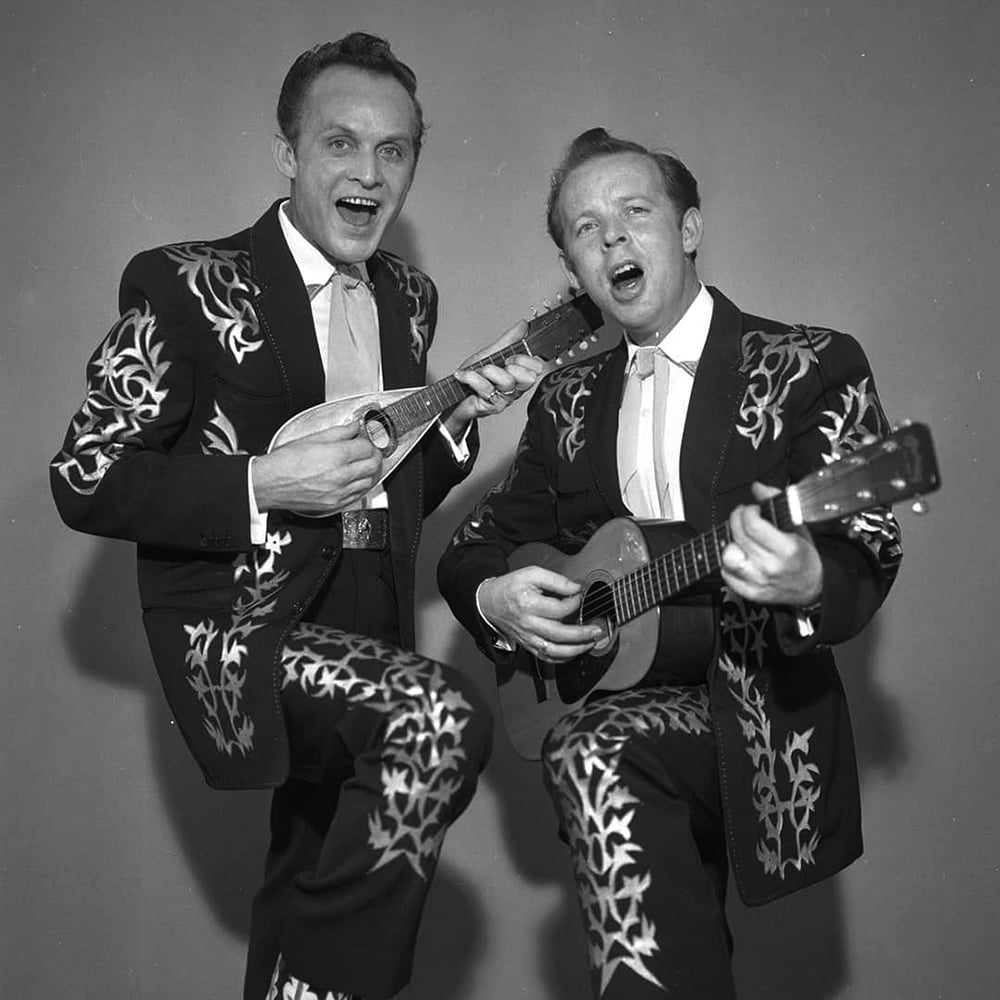
(Editor’s note: It is a pleasure to introduce our newest welcome columnist, Aynsley Porchak. Many of you may remember seeing Aynsley at Grass Valley when she performed for us with her band Carolina Blue a couple of years ago. She is not only a talented fiddler but also a scholar as her master’s thesis here shows. If you would like to read it in full with references, etc. you can find the complete work on the ETSU web site). Here’s Aynsley:
In a 2010 interview with American Songwriter, the respected Appalachian country music singer and songwriter Charlie Louvin was asked about the secret to musical longevity. Louvin candidly stated, “Well, I think that that’s one of the reasons that most Louvin Brothers songs have lived more than fifty years—because they challenge you”. Nearly sixty years after their peak, the Louvin Brothers are still considered to be one of the most influential and revolutionary duos in the fields of bluegrass and country music. While the brothers’ career was cut short by conflicting personalities and an untimely death, their music still retains great relevance through rediscovered, remastered, and revitalized classic recordings, championed by a handful of traditionalist artists and bands who were inspired by the duo’s harmonic mastery and poignant songwriting. Few country music partnerships have had the inventiveness of the Louvins, and it could be argued that even fewer had such a staggering impact upon both their peers and the whole of the recording industry. The Grove Dictionary of American Music claims that the Louvin Brothers were “probably the greatest traditional country duo in history” and Vince Gill’s statement that “you can’t find anybody [in country music], I don’t think, that was not inspired by them” speak volumes about the level of respect that the brothers obtained over their outstanding careers.
However, there is an aspect of this iconic duo’s work that has yet to be examined. As Charlie Louvin alluded, the Louvin Brothers’ songs are not only riveting, but also thought- provoking upon close examination of the lyrics. Some of the Louvins’ greatest hits, such as “Satan Is Real,” “When I Stop Dreaming,” and “I Don’t Believe You’ve Met My Baby” show a side of Appalachian music that is steeped in the balladry of the Scots-Irish settlers, the materializing genres of bluegrass and country music that were just starting to reach their peak, and the Sacred Harp shape-note singing traditions that were prevalent around the Louvins’ Alabama home. It is this blend of influences that combined not only to make them the musical powerhouses that achieved thirteen hits on the Billboard country music chart and five singles in the country music Top Ten, but also that made them an intriguing case study for this particular avenue of research.
I became familiar with the music of the Louvin Brothers through my studies at East Tennessee State University. I pursued two majors: my primary focus was the Bluegrass, Old- Time, and Country Music Studies program, but when I was in my second year of studies, I decided to add a second major in English. Both these degrees proved to be quite influential to this thesis and my career as a whole. As a Bluegrass, Old-Time, and Country Music Studies student, I had the opportunity to perform in the ETSU Bluegrass Pride Band for four years, which gave me a deeper understanding of musical techniques, genre themes, and historical figures in each of the titular genres. One of these early American musical groups that I was introduced to was the duo of the Louvin Brothers. The band of students listened to and learned to perform several numbers from the Louvins’ catalog of songs as a way of tightening vocal harmonies and learning about previous genre innovators.
While I had never heard the Louvins before my time at ETSU, I became fascinated with their dazzling harmonies and striking songwriting. When the time came to prepare a thesis, I found that this topic filled a niche within Appalachian Studies research, and I began to apply my English degree and my knowledge of literary criticism to listen even more carefully to the lyrical content that had so sparked my interest. As I listened to these talented artists, I was surprised and intrigued by what I found. The Louvin Brothers’ song catalog provides a thought-provoking commentary on many subjects, but I found that there were three primary issues that consistently appeared within their lyrics. In fact, these three themes surfaced in some way in many of their most popular songs—love, acceptance, and both the fear of and the act of rejection. However, the context in which they appeared proved to be even more important to me. Despite the contrast of their sacred and secular music, these same topics appear similarly in both. I will argue that while secular and sacred music contain defined musical contrasts, the lyrics of the Louvin Brothers show similar themes across these two genres.
An examination of Louvins’ lyrical themes through the dual lenses of both their own upbringing and regional Appalachian religion shows how certain songs can draw upon the topics in contrasting ways, and through close reading and lyrical analysis, I suggest that several of the Louvins’ hits point to the same underlying subject matter, effectively crossing the thematic, musical, and presentational boundaries between sacred and secular subgenres.
In this thesis, I begin by familiarizing the reader with the theoretical perimeters of my study, as well as situating my research within the larger whole of Appalachian Studies and introducing the forms of literary criticism that I will apply to illuminate the Louvin Brothers’ song catalog. Chapter One prefaces the lyrical investigation by tracing the development of Charlie and Ira Louvin’s careers from their humble beginnings to their eventual status as popular recording artists in an attempt to provide historical context that will inform my analytical discussion. In Chapters Two and Three, I take turns analyzing selected song lyrics that correspond to the themes of love, acceptance, and rejection within sacred and secular songs, respectively. I apply literary criticism to show the subtexts within the songs and explain their importance to the brothers’ lives while also showing the connections with their topical song partners. Through this analysis, I show the ties between the sacred and secular song lyrics in country and bluegrass music and show how the Louvin Brothers pioneered an approach to genre- crossing that was quite unusual for their time. The final chapter in my thesis examines the greater impact of Charlie and Ira Louvin within the greater whole of traditional American music, summarizes my findings, and encourages further research of these topics.
To create my analysis of the Louvin Brothers’ songs, I first established the framework of my research. The overwhelming majority of the duo’s sacred and secular songs referred to the topics of love, acceptance, and the fear of or the act of rejection. The transference of these themes across the subgenres’ divide, long kept separate, intrigued me, as it contrasts vividly with several aspects of early country and bluegrass music. Bluegrass historian Neil Rosenberg describes this concept in his book Bluegrass: A History, stating that most bluegrass or country musicians from the 1940s through to the 1960s sought to highlight the thematic, musical, and presentational division of these themes. He notes the separation that would occur between the regular, secular songs that most artists would construct a set of, and their careful introduction of a gospel or “spiritual” number, attempting to set up the dichotomy between the two styles and requesting the audience members to listen carefully.
Stylistic musical variances were present as well, such as different instrumentation and utilizations of more complete harmony stacks in contrast to the two- and three-part harmonies that were standard on many of the secular songs. Naturally, the thematic elements also varied considerably, with the secular songs often containing lyrics that depicted drinking, murder, and both emotional and physical love in stark contrast to sacred songs centered around prayer, holiness, and the love of God. For these reasons, the mid-20th century country music industry frowned upon too much interaction between “holy” and “common” musical forms, and even the single most influential platform for country and bluegrass music during this time, the Grand Ole Opry, specifically limited the amount of gospel music performed during certain shows because of the nature of the show’s sponsors, which did not always fit the image portrayed in the songs’ lyrical content. However, author Thomas Wilmeth adamantly depicts the rebellion of the Louvin Brothers against the carefully maintained chasm between sacred and secular subgenres. Wilmeth states in The Music of the Louvin Brothers: Heaven’s Own Harmony that the Louvin Brothers, who were not accepted by the traditional gospel community for dabbling in secular music and instrumentation and who frequently made country audiences “uncomfortable” with their references to sin and guilt within religious pieces, chose to maintain their individuality nonetheless. During their personal appearances, Charlie and Ira Louvin performed both sacred and secular songs equally with little regard to the established sacred and secular subgenres in a way that rebelled against the industry’s “established image[s]” and even composed many of their songs with “themes familiar to gospel songs … applied to a completely secular situation”.
With this in mind, I determined to isolate the topics that appeared in the Louvins’ song lyrics and select sources that presented supportive perspectives and approaches accordingly. From these resources, I selected three forms of literary criticism to inform my analysis of Charlie and Ira Louvin’s songwriting. The most commonly utilized of these three criticisms is the method called “close reading.” It is one of the most basic forms of literary analysis, and stems from the New Criticism and Deconstructionist movements. Close reading uses the reader’s basic deductions to find the implied cause and effect of a given statement, event, or object. The Johns Hopkins Guide to Literary Theory and Criticism defines it as a form of literary criticism “in which the poem or literary text is treated as a self-sufficient verbal artifact—a unique and privileged source of meaning and value”. The priority is given to the text itself and whatever meanings the reader may derive, rather than the influences of culture or history. I will be using close reading as the first level of criticism in Chapters 2 and 3 to show the impact of lyrical import upon the listener. As well, I will draw upon the theory of new historicism, which author and literary critic Peter Barry defines as “a method based on the parallel reading of literary and non-literary texts, usually of the same historical period . . . in which . . . texts are given equal weight and constantly inform or interrogate each other” (Barry 173). Formed in the 1970s by critics such as J. W. Lever and fully developed and defined in the 1980s by Stephen Greenblatt, new historicism was developed as a reaction to the practical theory of close reading as a way to look past the words on paper and instead see them within the greater context of the modern times. This particular form of theory will be valuable for my examinations of song lyrics (which I will be using as the “literary” text) while contrasting them against biographical works (which will represent the “non-literary” text).
While both of these forms of literary criticism are undoubtedly essential to this thesis, another analysis creates another crucial facet for this work. The very nature of the music that I am investigating requires an examination of the applied thematic elements, and to accomplish this, I decided to select a form of analysis that best incorporates religious themes. While religious literary analysis is not widely acknowledged, it is nonetheless present in modern criticism. Nathan A. Scott, Jr.’s 1953 article “The Relation of Theology to Literary Criticism” was one of the first pieces to propose the themes that later critics such as P. Joseph Cahill and Luke Ferretter would develop. According to Dennis Taylor in Seeing into the Life of Things: Essays on Literature and Religious Experience, this form of criticism “discuss[es] religious or spiritual dimensions in works of literature” and draws out the references lifted from the Bible or similar holy texts. As I determine the parallel themes between the sacred and secular lyrics of the Louvin Brothers, I will be using religious literary criticism to provide insight into the allusions and iconography that the duo so frequently and vividly used.
I also was struck with the lack of research on lyrical analysis within ethnomusicological studies, and I determined to create a list of references that would span a wide range of perspectives and years. I reference three works as biographical sources to inform my discussion of the Louvins’ lives. Author Charles Wolfe chronicled the Louvin Brothers’ career through painstaking historical research and interviews with Charlie himself to create his 1996 book In Close Harmony: The Story of the Louvin Brothers. Thomas Wilmeth produced a volume two years later, entitled The Music of the Louvin Brothers: Heaven’s Own Harmony, notable for its extensive discography and analytical perspective. More recently, Benjamin Whitmer had collaborated with Charlie Louvin to publish the duo’s life story in Satan Is Real: The Ballad of the Louvin Brothers, which was released in 2013, shortly after Louvin’s death, and depicted the musicians in vivid detail, spreading new light on the stories that had been circulating for decades. I supplemented these three books with several additional individual interviews with Charlie Louvin to provide insight into his life after the brothers disbanded. Journal articles from American music scholars such as Bill Malone, Michael Grimshaw, and Charles Wilson Reagan explore the selected songs’ interconnected themes, while seventeen songs from Charlie and Ira Louvin’s celebrated albums provide a basis for literary analysis. I analyze the presence of selected core lyrical themes in the lives of Ira and Charlie Louvin, the topical impact upon their works, and their navigation of the balance of sacred and secular songs to provide an original and modern perspective on these topics.
