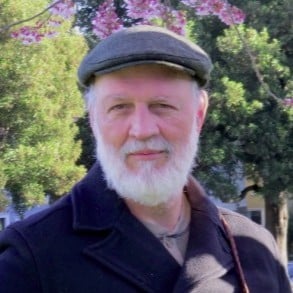
I caught up with during lunch break after the New Real Time Travelers’ set at the CBA Father’s Day Festival, 2016. Ben is a multi-instrumentalist, songwriter, producer, and recording engineer. He’s played many stages over the decades throughout the U.S. and Europe, plus in his Rocky Mountain home with bands such as Loose Ties, Kane’s River and Growling Old.
Dave: Hi Ben. Thanks for taking time from your Father’s Day Festival schedule. Can you tell us a little about your early days in music?
Ben: I’m from New England outside of Boston, so I didn’t grow up in a log cabin in the south. My sister and mother sang a lot of folk songs around the house and I also had an aunt who played the banjo, so I was exposed early on through my family.
Dave: Did you have any formal lessons?
Ben: Yes. I took piano in grade school. My mom said if I took three years of piano lessons, then I could study whatever I wanted. So around the 6th grade I just thought the banjo was for me.
Dave: Was it just from your aunt where you were hearing the banjo?
Ben: Yeah, pretty much; she was kind of a hippie. I didn’t hear it from the Beverly Hillbillies or Bonnie and Clyde soundtrack like many others. My aunt played mostly Pete Seeger songs. I got the Pete Seeger book and worked on it some, but then I found a local guy Clyde Franklin who was a hard-core Scruggs player and my first instructor.
Dave: How long did you keep playing that banjo?
Ben: I went away to high school and pretty much gave up the banjo and got into playing electric bass and a little guitar. It was all jazz, Little Feat, and Grateful Dead for a long time.
Dave: How did you find your way back to folk, bluegrass, and old time sounds?
Ben: In college I had this idea that I wanted to be a luthier, so I built a guitar on my own and started getting into acoustic music again. I took a guitar-building course one summer in Vermont. In my free time I made a mandolin but had no idea what to with it.
Dave: So that’s when you started playing the mandolin?
Ben: Yes. I finished that mandolin right around the time the first David Grisman Quintet album came out. I was blown away by that, so I spent all my free time in college learning how to play the mandolin. I was pretty much self-taught.
Dave: So building that mandolin brought you back full circle.
Ben: Yes. When I think about what I listened to in high school versus now, as I’ve gotten older I’ve gone backwards, listening to older and older music.
Dave: You played an octave mandolin in that last set. Is that your regular instrument with this band?
Ben: Yes. It’s an interesting dilemma. A six-piece band is pretty unwieldy and has a lot of strings, so it’s hard to find your place. With Carol Elizabeth playing full chords on guitar, we definitely don’t need another guitar or mandolin, so there’s a role for the bouzouki most of the time. I recently started playing banjo uke on some fiddle tunes where there’s some space for that, especially when Roy picks up the fiddle and they do twin fiddles.
Dave: That was cool version of Shady Grove you all played. Where did that come from?
Ben: I learned it from a clawhammer banjo player named Chris Coole from Toronto, and he said it came from the autoharp player Kilby Snow. There are a lot of versions of Shady Grove, but that one was pretty different and we liked it.
Dave: What is it like for a band from the old time tradition playing bluegrass festivals?
Ben: I think it’s great to be here. I played in bluegrass bands for years, and I’m probably the only one in this band that comes from that world. The others came up through the folk and old time ranks.
Dave: What bluegrass bands have you played in?
Ben: I played with a band called the Loose Ties that toured around some, and Kane’s River, which was more of a progressive bluegrass band. It seemed like the way for a bluegrass band to make a mark was to be either more traditional or more avant-garde than the rest of the bands, but showing up at a bluegrass festival as an old time band, well, no one else is doing that.
Dave: Is it uncommon for bluegrass festivals to have old-time bands?
Ben: It’s more common in the west, where it’s a little more open to mixing and matching.
Dave: So where would you play in the east if not at a bluegrass festival?
Ben: Places like Merlefest are more open to it because Doc Watson played everything. A handful of festivals back east are receptive to both kinds, but my favorite thing is to come to a festival like this, which is 90% bluegrass so what we do stands out a little more.
Dave: Where did the band name come from?
Ben: It was the Reeltime Travelers for quite a while with Thomas Sneed and Roy Andrade, who are both in this band. This is just kind of the new version of that where they wanted to preserve the name but the players were a little different.
Dave: I’ve noticed a ragtime influence in your sound that reminds me of other bands like the Red Clay Ramblers or Hot Mud Family. Tell us about that.
Ben: There are different styles in old-time, not unlike bluegrass where bands fit the Stanleys mold or try to sound like Alison Krauss. There are old-time bands that play just the mountain style fiddle tunes, but in this band we’ve all been exposed to a wide variety of music. The New Lost City Ramblers comes to mind as a band like that, playing primarily old time string style music but also some bluegrass and goofy comedy songs, blues, or what have you.
Dave: You do producing and recording too don’t you?
Ben: Yeah, that’s the other half of what I do. I have a studio in my backyard in Idaho near Jackson Hole, Wyoming, and make a lot of CDs for other bands. I’m in a remote area, so I do pretty much whatever comes along. It’s not like I specialize in one thing or another. There’s a lot of western cowboy stuff in my neck of the woods, actually some really great cowboy harmony bands. There’s an amazing bottleneck guitar player Mike Dowling who I do a lot of stuff with.
Dave: Do you teach?
Ben: I do a lot of workshops and private lessons. I taught guitar this week at the camp but I prefer to stick to mandolin. I’ve also done vocal and songwriting workshops but mandolin is what I feel I’m best at.
Dave: How was teaching at music camp this week?
Ben: It was really great. I was impressed with all the different workshops; it blew my mind how many electives there were. The whole vibe was great, how all the staff seemed super willing to interact with the students, and there weren’t any big egos or anything. It was also great to hang out with some of my West Coast pals Keith Little, Jim Nunally, John Reischman, and others.
Dave: As an instructor, how do you get people to the next level?
Ben: I feel it’s a challenge for these camps. I don’t want to sound negative, but in a lot of ways I question the model of a three or four-day camp as a good way to learn. With private lessons if I notice something in a student’s playing that needs to be fixed, I spot that pretty quickly and I can say say go home and work on that then come back in two weeks. I mean, until you fix that, you can’t really progress to the next thing.
Dave: So what do you see as the biggest benefit for most camp students?
Ben: The thing they get the most out of camp is coming somewhere and just holding and playing their instrument for several hours a day, which they may never do at home. The jamming at night with players who are open to let you into their circles is something they benefit from.
Dave: There must be students who benefit more than others?
Ben: Yes. Occasionally you catch students who are able to digest it all and be right there with you at every step. But in a group setting it’s virtually impossible to find eight students who are all at the same level and able to take it all in at the same time. Usually you’re going to end up leaving someone in the dust, or if you’re going too slow the more skilled players start getting bored.
Dave: What do you feel is the best approach for the students coming to music camp?
Ben: The best thing is when the students are really inquisitive, because then you can tailor it to what they need and what they want. I always show up with an image of this generic student who’s going to want to learn these things I have prepared, but then that person is never there. I then have to adjust on the fly, which is my biggest challenge but also super rewarding when it works. I learned a long time ago I need to prepare plus always have a few tricks in my back pocket.
Dave: Do you actively play with other bands?
Ben: I play with John Lowell in a duo called the Growling Old Men. We’re planning to come on a little tour in the Northwest and maybe dip down to play some shows in California. We have some friends, Ann and Pete Sibley that I used to record with who live in the Monterey area, so we hope to play some shows with them.
Dave: Do you have any favorite memories from the festival?
Ben: Oh yea, maybe attempting to play a mandolin solo on Muleskinner Blues during the staff concert with Nunally, Little and Sprouse with one of my A strings about two steps flat (with Reischman watching…) or playing a set on the main stage and then jamming in the campground about 25 minutes later or having my picture taken in front of Rhonda Vincent’s bus…
Dave: That’s great, thanks for your time Ben. We hope to see you back at the FDF and of course readers can find all your shows on the websites below.
Ben: You’re welcome Dave.
http://www.newreeltimetravelers.com/
http://benwinship.com/
http://www.growlingoldmen.com/
http://brothermule.com