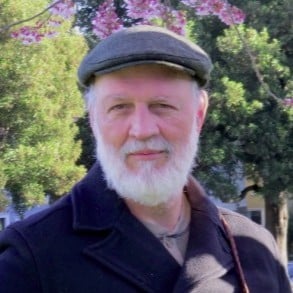
This month’s interview is with the great fiddle player Blaine Sprouse, whom I had the pleasure of chatting with before the Peter Rowan Bluegrass Birthday Fourth of July Barbeque show at Rancho Nicasio. Blaine’s resume is long and impressive from Jimmy Martin, James Monroe, Charlie Louvin to many other greats. He now resides in Northern California.
Dave: Hello Blaine. Nice to meet you. Can you give us a short recap of where you grew up?
Blaine: Sure Dave. I grew up in the country outside of Hedgesville, West Virginia, near Martinsburg. My dad worked in a woolen mill near Baltimore, then later in the B&O Railroad shops in Martinsburg.
Dave: That’s up in the eastern panhandle near D.C., isn’t it?
Blaine: Yes, Berkeley County, which is now a bedroom community about 75 miles from D.C. There were lots of apple orchards and dairy farms there back then but no coal mining. They tore up all the orchards and built cheap condos, so it’s nothing like it was then.
Dave: What were your early musical connections?
Blaine: Dad sang and played clawhammer banjo and some guitar. In the ‘40s he had a Saturday morning radio show, I believe out of Winchester, Virginia. He had a great collection of music: Flatt and Scruggs, George Jones, the Stanley Brothers, Bill Monroe, basically everything. I mean, just stacks and stack of 78s and 33 1/3 LPs. Eddie Arnold was one of his favorite singers and he had all of his 78s.
Dave: Did you have siblings that played?
Blaine: I’ve got a half brother and sister who expressed an interest in music, which was a normal thing for a lot of kids. Dad got them instruments but after two or three weeks they lost interest, so he wasn’t really excited about me playing music.
Dave: How did that impact you?
Blaine: When I got interested Dad said, “I’m not going to go to out and buy you a guitar. I’ve got a guitar that I loaned your uncle, so when we go up to see him in Craigsville [Virginia] for the holidays, we’ll get it back and you can use that.”
Dave: What kind was it?
Blaine: It was a Gibson, one of the smaller models. I don’t remember which one but it had a sunburst finish. He showed me three chords – I think D, G, and A – and I started practicing and just went from there playing along with Hank Williams records.
Dave: Did your dad play with you?
Blaine: Yes. I’d play guitar along with him on banjo on the weekends and sometimes at night after he got home from work.
Dave: When did you first hear bluegrass?
Blaine: I can’t remember for sure, but I think it was in Salem, Virginia at Lakeside Amusement Park where I saw Bill Monroe in person for the first time. That was around ‘67 or so, around the time Carlton Haney started his bluegrass festivals at Cantrell’s Horse Farm in Fincastle, Virginia. I heard Kenny Baker and it was all over for me on guitar.
Dave: Wow, just like that?
Blaine: Yep, just like that. When I heard Kenny play Muleskinner Blues, I was like, that is what I want to sound like right there, I want to make that instrument sound like that. I was a goner.
Dave: How did you get your first fiddle?
Blaine: I was playing at dances at the American Legion in Martinsburg, where my dad would take me. I made $20 a night and I started saving my money. Around the same time, a friend Lawrence Houk said had found a fiddle that was busted up in a dumpster. He glued it back together, strung it up and gave it to me. He said, “Blaine, I heard you wanted to play fiddle”. I didn’t have a bow, so I learned to pick Old Joe Clark and a few things on fiddle.
Dave: Were you playing fiddle at the dances?
Blaine: Oh no. I was playing take-off lead guitar then. I was just starting on the fiddle, kind of just picking out stuff. With the money I saved I eventually bought a little 3/4 size fiddle and a bow. I finally learned to use the bow a little bit but never really took lessons from anyone. I just watched Kenny play and Buddy Spicher on the Wilburn Brothers show. I also followed Mack Magaha from Reno and Smiley, who played on the Port Wagoner show.
Dave: There were a lot of local country TV shows back in those days weren’t there?
Blaine: Yes. There was the Buck Owens show, the Reno and Smiley show down in Virginia sponsored by Kroger, and of course the Porter Wagoner show.
Dave: I remember some of those. Was that Porter and Dolly?
Blaine: We started watching that before Dolly, when Pretty Miss Norma Jean was singing with Porter.
Dave: How were you able to learn from TV shows before VCRs and such?
Blaine: So I’d watch that and then work along with the records. I’d slow ‘em down and pick ‘em out. I had to retune the fiddle, but I found out how to do it someway or another. I’d learn it note for note then once I thought I knew it, I’d tune my fiddle up to standard tuning which was was good practice for me.
Dave: When did you start playing out on fiddle?
Blaine: Well, later on I played with my cousin in the Sprouse Brothers and that’s how I come to meet Jimmy Martin in Waynesboro, Virginia at a smaller festival.
Dave: How did you go so quickly from learning to playing with Jimmy Martin?
Blaine: I met Jimmy in 1974 when I was 17. I’d played with my dad prior to that when Carlton Haney started sponsoring festivals at Watermelon Park in Berryville, Virginia. My dad and my sister and I would camp out and we’d jam a lot.
Dave: Were you still in school when you started playing with him?
Blaine: Well I dropped out of high school when I was 17 when Jimmy Martin offered me a job. It worked out ok, although my dad didn’t want me to drop out of high school because he grew up in rural Virginia and they took him out of school in the 4th grade to work on the farm.
Dave: So you were on the fast track out of Virginia.
Blaine: Well, I had the wanderlust, I guess you might say, because I wanted to get out and see the world, and the preferable route was music. The alternative was the marines, and I’m sure glad it worked out the way it did because I wouldn’t have made a good marine I don’t think. I would’ve asked why the sergeant wanted me to move that pile of sand.
Dave: So Jimmy Martin was your first big break.
Blaine: Yes. He was first and I lived with him for six months and finally saved up enough money so that the banjo player Dwight Dillman and I moved out and got our own apartment.
Dave: Was that in Nashville?
Blaine: Yes, I was based in Nashville. After Jimmy I played with James Monroe and the Midnight Ramblers, and it was there that I played with Alan O’Bryant, who many folks would be familiar with. Alan and I got to really hang with Kenny Baker a lot. I’d met Kenny when I was about 13. He asked me to get my fiddle out and I played a tune for him, and about half the way through I got nervous and forgot it. He said, “Now by god kid, I tell you what. When you get to Nashville you look me up” and I did.
Dave: Did Kenny remember you?
Blaine: Yep. Jimmy Martin took me out to see Kenny and he remembered me. Kenny would pay me I think it was like $20 a day to knock around the farm with him. After we did all that, about 4:30 or 5:00, we’d go in and start playing some fiddle and talking and have a few cold ones.
Dave: How long did that continue?
Blaine: Gosh, that went on probably four or five years, and in those early years I’d be out there all the time. Then I left James Monroe, and I think it was with Charlie Louvin I went with next.
Dave: You played with a lot of the greats. Were there some that stand out as being more important for your development?
Blaine: Well of course, they were all important. Jim and Jesse and the Osborne Brothers, which was all before I went to law school. I dropped out of the music industry for a while.
Dave: Right, what caused that change?
Blaine: My dad passed away in ’85 and I got very introspective. I think it had something to do with me not finishing high school. So I got my GED and I really enjoyed reading and ended up going to a community college and getting a two-year degree. Then I ended up at Vanderbilt and got my bachelors degree.
Dave: So you dropped music entirely?
Blaine: I took a year off after that and went back on the road with Jim and Jesse. Afterwards I took the LSATs, got into Vanderbilt Law School and graduated law school in ’94. From ’94 on until about 2009 I worked as a lawyer in Nashville.
Dave: Was that work related to the music business?
Blaine: I did some music business work but I mostly did litigation and appellate work and ended up in the Attorney General’s Office as an assistant.
Dave: So what pulled you back to the music?
Blaine: What happened was a divorce and my ex went to California. She had a sister in Santa Paula, and I would fly out to California once a month to see my son, who was about three at the time. It wasn’t working for me, as I wanted to see more of him and be closer. I ended up moving out to Ventura. I quit my job with the state of Tennessee, but that was in 2008, not a good time to be starting somewhere. I didn’t want to take the bar exam right away so I got a job as a paralegal. I only worked a couple of months and was laid off for the first time in my life. Luckily I was able to draw off of what I made in Tennessee.
Dave: Did you connect with any pickers in Southern California where there’s a rich bluegrass history?
Blaine: I didn’t have a lot of luck. Peter Feldmann in Los Olivos was the first real music job I guess you’d say that I had. He’s a very good mandolin player and close friend now. About 2009 I pulled my fiddle out from under the bed. I hadn’t played it for about a year so I decided, heck, I might as well play the fiddle because I couldn’t seem to find a job elsewhere. I do remember making the conscious decision that I’m not going to take the bar exam, I don’t want to be a lawyer.
Dave: So you were probably pretty happy to be playing music again?
Blaine: Yes. I was playing music again and it felt so good. Sometimes getting away from something you love like that is good for you. So I got back into it and gosh, one thing lead to another and things started opening up. Anytime I tried to do anything with business or something to do with law, I couldn’t make it work, but musically I did.
Dave: Tell us more about some of those music opportunities that opened up.
Blaine: Well, I met a friend, Tim Weed, who lives just over here in Nicasio now.
Dave: That’s Tim Weed known for his recording studio, right?
Blaine: Yes, he has a studio but he’s also a great musician. He was working on a CD and he asked me if I would put some fiddle on it. He was in Inverness at the time and I was in LA and not liking it at all. So I came up and set up for about a week at his house.
Dave: That sounds like a big change.
Blaine: Yes. I remember the first morning I woke up and the trees were blowing in the wind and I was like, this is so much better than LA and Peter Rowan lives just over the ridge. I’ve known Pete gosh since ’76 or ’77 from Bean Blossom and we’d played some off and on. So Pete was like, hey, I’m doing Hardly Strictly Bluegrass. Are you busy the first weekend of October? I was, like, no.
Dave: Well that’s a great welcome to Northern California.
Blaine: Yes. We did that and then he had other shows, and the next thing you know, I’m moving up here and became a regular member of his band. I also love Western Swing and started working with Don Burnham and Lost Weekend.
Dave: So you must know our friend Pam Brandon who plays with them.
Blaine: Oh yes. She’s great and a lot of fun. Now I’ve started meeting all these other people that I really enjoy playing music with, and making some new friends like Eric and Suzy Thompson.
Dave: Are there other fiddlers that were big influences on you?
Blaine: Oh Lord yes. Of course Kenny Baker was the major influence because, like I said, his playing spoke to my soul somehow. Vassar Clements was an influence. I remember when the album Will the Circle Be Unbroken came out, which was the Nitty Gritty Dirt band project. Man, that set me on fire, so I was Vassar crazy for a while.
Dave: I’m guessing you liked his Hillbilly Jazz album as well.
Blaine: Oh, I did. I loved that and Benny Martin as well.
Dave: You ever hear Tex Logan?
Blaine: Yes. He lived in New Jersey and worked at Bell Labs.
Dave: What was it about Kenny Baker that touched your soul as you say?
Blaine: It’s his tone and the smoothness. Some people are more attracted to the more raw mountain sound and some people like the, for lack of a better word, more elegant sound. I was attracted to the prettier stuff. I like string quartets; I like Stéphane Grappelli and Joe Venuti. Kenny had that beautiful tone, and he could state the melody so well. His taste was just exquisite, the way he backed up Bill’s singing. He and Bill worked together hand in glove, and that’s what really attracted me to his playing. He was so melodic in his playing.
Dave: What can you say about those fiddle tunes Kenny and Bill played together and how they came to their final form?
Blaine: Kenny played swing before he played bluegrass. He worked with Don Gibson’s western swing band, so he loved swing music a lot. Marion Sumner, the great fiddler who was from the same region of eastern Kentucky that Kenny was from, was a big influence on him, and you can hear it if you listen to some of Marion’s work.
Dave: So even though Kenny was from eastern Kentucky, he brought a more polished sound to Bill’s tunes.
Blaine: The way I look at Bill Monroe’s writing fiddle tunes and Kenny interpreting them was Bill was more like an impressionist painter; he didn’t fill in the details. This is the structure – the skeleton – and Kenny could take that and make it magical. I worked with James [Monroe] and I worked a while with Bill filling in when Kenny cut his hand, and Bill taught me Old Ebenezer Scrooge when he was working on that.
Dave: Is there a story about that?
Blaine: We’d be back stage at the Opry in the room there sometimes for a couple of hours working on this tune, and he’d say in his Bill way, “Do it like this” and I would. That’s a four-part tune, and on the C part of the tune I was playing the notes but I wasn’t doing it the way he wanted. So he showed me how to do it and said, “Do it like this right here and them other fiddlers they won’t be able to do it like that, don’t you know.” He was always competitive. Then he was like, “You know you should record that tune, that’d be a good number for you” and I did. Some things Bill would let you do your way. If he pretty much liked what you were doing that would be fine, but there were other times when he wanted it to be exactly like he wanted it.
Dave: Thanks Blaine for your time. I know you’ve got a show to do.
Blaine: Your welcome Dave.
REFERENCES
Blain Sprouse Music
http://blainesprousemusic.com/
Sprouse Brothers playing Big Sandy
https://www.youtube.com/watch?v=W4opJiRJAQA
Blaine Interview on Bluegrass Today
http://bluegrasstoday.com/blaine-sprouse-remembers-kenny-baker/