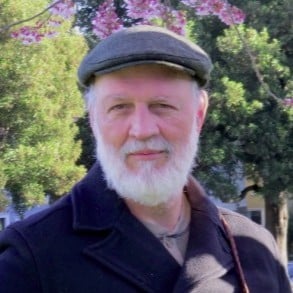
This month’s chat is with Thomas Wille who may be best described as the meat and potatoes of the San Francisco bluegrass scene. He is active in many bands but best known for guitar, vocals and mandolin picking in Windy Hill and the Earl Brothers.
db: Hello Thomas. Tell us how you first got hooked on bluegrass?
tw: I first got interested in bluegrass music out of an interest in honky-tonk country music. I started listening to country songs in college. Later, I was in Paris to visit a girlfriend and met a banjo player in her dorm. We played about eight or nine songs together and they came off very easy. I was amazed, so after that I became more and more interested in bluegrass.
db: What instruments do you play?
tw: I took piano lessons as a kid and taught myself guitar in high school. I taught myself to play mandolin in college and then in recent years I’ve learned to play upright bass and the five-string banjo. I think I can still play some harmonica too, but I’m not sure.
db: Growing up was of your family musical and if so in what way?
tw: My mom can play the piano and sang in her church choir when she was younger. My sister took piano lessons as a kid and sang in a children’s choir, and my dad played the trombone in high school.
db: Who was your biggest musical influence growing up? And now?
tw: My parents were my biggest musical influence growing up. I listened to and developed my musical taste based on the things they liked. Now my biggest musical influence is my band mates.
db: Do you do any composing?
tw: I generally compose to play the songs in a band when we’re getting ready to work on a recording project or something like that. Sometimes I write songs when I’m sad in the hopes that I can focus more and write a good song.
db: What instrument is the most comfortable for composing or learning new tunes?
tw: They all have their positives and negatives but I don’t think about the instrument at all when composing. When learning a new tune, I’m a firm believer in studying the history, learning from the record and the style of a particular performance.
db: Can you give an example?
tw: Say I wanted to learn how to play Lonesome Road Blues. Saying that in the abstract means nothing to me. I would want to learn how to play Lonesome Road Blues on the banjo in a particular way like how Earl Scruggs played it or how Ralph Stanley or Don Reno played it. On the guitar I might want to learn how Bill Napier or George Shuffler played it and think about how I would want to sing the song. I do the least note-for-note learning when it comes to guitar lead. My favorite singing version of Lonesome Road Blues is by Larry Sparks and Ralph Stanley from the late 1960s on one of the Jalyn Records. Ralph plays clawhammer on that track and I have no idea how to do that.
db: Tell us about the bands you’ve played in.
tw: I played in a band in college with friends and we had one gig to play Abbey Road from beginning to end. My first bluegrass band was a couple years later when I played mandolin and sang in Julay Brooks and the Night Birds. Julay played guitar, Larry Cohea played banjo, and Pat Campbell or Bruce Campbell played bass. Tom Lucas fiddled, and Jim Minton played dobro. We only played a few shows but we practiced a lot. I developed tendinitis in my right elbow so I kind of quit for a year. I’ve never really played mandolin full-time since then.
db: What came after that?
tw: A year later I joined a band called the Burning Embers led by Eric Embry and Katy Rexford. I played acoustic and electric guitar. Eric played banjo and guitar, Katy and Diana Greenberg played fiddle, Josh Lazarus and then Tom Armstrong played bass, and Les James played drums. We were a honky tonk band that played some bluegrass. We played a lot at the Riptide bar out in the Sunset District of San Francisco. We recorded an EP that never came out. We dug deep into 1960s country music especially male-female country duets, which Eric and Katy could perform convincingly.
After that I played a lot more with Eric Embry and we started a Stanley Brothers cover band called Shed House. We didn’t play very many gigs but we practiced a lot using the band as an excuse to seriously study the music of the Stanley Brothers. Jon McNeil played bass and Rob White played fiddle. Later on I joined the Earl Brothers on mandolin, guitar and vocals, and a year after that I replaced Yoseff Tucker in Windy Hill. I currently play in both those bands.
db: Do you have any recent or upcoming recordings?
tw: Windy Hill has a new album in the can being mixed and mastered. It should have 15 to 18 original bluegrass songs.
db: Have you ever toured with any bands and if so, share some thoughts from the road.
tw: I’ve toured with both the Earl Brothers and Windy Hill. The Earl Brothers is a more veteran band and has a definite leader – that’s Robert Earl Davis. Things go very smoothly and everything’s taken care of by Bobby so I just follow orders. We haven’t done anything longer than four or five days since I’ve been in the band. I have much more responsibility in Windy Hill and we have hit the road pretty hard. We’ve toured three summers across the western states and two years ago we did a 40-day tour. We all went crazy and suffered, but of course we had wonderful times.
db: How do the tours affect the bands’ playing?
tw: Playing night after night is the only way to get really good at playing bluegrass. You learn something new about the music going from town to town and from bar to bar. I generally don’t like to travel, but playing with friends, performing in every town, I find that I actually can enjoy traveling. When you’re on tour you make a little money so you’re not just traveling and bleeding money like you do on a normal vacation.
db: How were the crowds?
tw: You meet people who want to talk to you everywhere you go, which is really good because you get a little bit of local flavor and stories. The other guys in Windy Hill are very outgoing and I’m not so much, so they kind of make me do things outside my comfort zone, which has been good for me.
db: What interests you when you are not playing music?
tw: I’m interested in film, history, politics… For the last few years I’ve been very interested in the history of professional wrestling for some reason. I listen to tons of podcasts about it and I can’t seem to get enough.
db: Are there any shows coming up this year you’re looking forward to?
tw: The Earl brothers are playing at Wintergrass and I’m very much looking forward to that. I’ve never been before and I feel like we’ll go over well.
db: What shows or venues stand out?
tw: A number of festivals with the Earl Brothers stand out: we went to IBMA the last two years we also played the Durango Bluegrass meltdown in Colorado, and that was really beautiful. With Windy Hill memorable shows include winning the band competition at the string summit in Oregon, playing in Canada, playing at the Canal Street Tavern in Dayton Ohio where Red Allen used to play. We met his sons and played music with them. My favorite Windy Hill show though was probably the Darrington Bluegrass Festival where we played well and it was just beautiful. With the Burning Embers, I played on an episode of Dirty Jobs, which was very great.
db: Do you often get a chance to play with locals?
tw: Yes. One of the best places I’ve been to see bluegrass music is Rosine Kentucky for the annual Jerusalem Ridge Festival. It’s one of the only places left in the country where you can see old time bluegrass music presented in a traditional way and in front of an audience that appreciates it. During that trip I was fortunate enough to go back to the hotel room with a bunch of the ex Clinch Mountain Boys and play and sing all night. It’s still the most amazing musical night I ever had, especially hearing and singing with Danny Lee Davis who can do almost perfect imitations of Ralph Stanley, Red Allen and Carter Stanley. His vocals are so loud and piercing I had an almost out of body experience.
db: What CBA events have you played?
tw: I’ve played at the Grass Valley Father’s Day Bluegrass Festival with Windy Hill and I’ve played as an IBMA showcase band with the Earl Brothers. I’d like to play more in the future.
db: You seem to prefer the traditional style. Tell us why that grabs you?
tw: Yes but I’m not really sure why. Maybe it’s that I’m interested in history and thus the music of the past is more appealing to me. When I first got into traditional bluegrass I liked that it was very, very sad. Bill Monroe and the Stanley Brothers made such sad music and their voices sounded like they were screaming in pain. I often like kind of rough music; the modern slick bluegrass doesn’t appeal to me very much. The lyrics in bluegrass music are very important; the imagery and themes are essential to what I consider bluegrass music. I like my music to have authenticity but there’s no real definition of that – I just happen to find it in the old bluegrass music.
db: Are there any particular eras of traditional music that are your favorite?
tw: My favorite eras in bluegrass are the 1940s, ’50s and ’60s which is true of country music as well. I like the recording technology from that era and feel like the records sound the best. I like the styles that everybody played in that time on the instruments and the way people’s voices sounded. There’s very little bluegrass from this time that I don’t like actually. This is when all the great bands made bluegrass.
db: Do you think this genre is being preserved and will continue to thrive?
tw: That’s a really hard question to answer. I think some people are preserving it but that bluegrass has lost what largely makes it a unique genre to me, at least among the top-notch players. Granted if there were a big audience for traditional bluegrass, then you would see more tiptop players. I think mostly the farming and mountain audience is just much smaller than it used to be and it never was that big to begin with. It stays alive via jamming at bluegrass festivals, which is still a place where the old songs have hegemony. I think in bluegrass you have to know and play the old music. If you don’t then you’re not really playing bluegrass. You might be influenced by it, but you’re not really playing it.
db: Can you share some techniques that have helped you get better?
tw: Playing with the metronome is a really good idea and learning to play fast is really important. Playing with people that are better than you and deferring to them and listening to them is also good. It’s really important to perform with different sound set ups. In this era after rock ‘n’ roll, soundmen often don’t know what to do with bluegrass. Record yourself and listen to the recordings; criticize yourself and never stop trying to get better.
db: What’s your approach to singing?
tw: I’ve made a concerted effort to sing in a style that I consider bluegrass – that mountain style of singing. It means a lot of falsetto and high and hard. I also try to sing and pronounce the words in that style, although I have probably toned that down over the years.
db: Finally for the geeks out there, what instruments do you play?
tw: I have a Gibson A-9 mandolin. I have a Martin D-18 guitar from 1971 or ‘72. I have a Kay bass from the ‘60s and a Gibson arch top banjo from 1961 or ‘62.
db: Any final thoughts or things you want to share with the readers?
tw: Come see me play sometime. If you have questions about songs or what I do, feel free to ask. I love to talk specifics about bluegrass. I know a lot about the history of it and I’m happy to share whatever I can. Email or Facebook me. If you want lessons, let’s do it.
db: Thanks so much Thomas, great stuff.