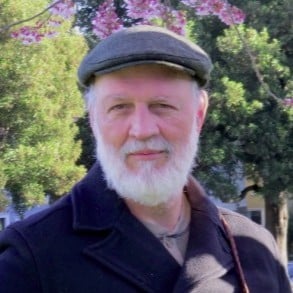
Avram Frankel is a Bay Area native and lifelong musician who started playing bluegrass about 10 years ago. He lives in Pacifica, California with his wife Vicki and daughter Dana, who also play bluegrass.
db: Most pickers have a geographical or family connection to traditional music. Tell us how you first got hooked.
af: Wish I could say I was born in some deep holler, but it was more like a deep suburban cul de sac. Most of my family was not musical, but there was a line from my maternal grandfather running through an uncle and my mom to me. My uncle plays clawhammer banjo and has built banjos and mountain dulcimers. My granddad was an excellent organist and pianist. My mom and dad were avid music listeners, mostly country and pop stuff, and always supported my musical endeavors. I really have to give them credit on that.
db: So I assume you started playing music as a youngster.
af: I played in bands all through high school and eventually became a pretty accomplished orchestral percussionist and also started picking up rockabilly gigs on drum kit. I was in a solid rock n roll band all through college and continued with that for a while after I returned to San Francisco from back east. There were other bands and all the while I had a guitar that I played quite poorly.
db: How did you get into bluegrass?
af: I came to acoustic music in the early 90s, through bands like Wilco, Son Volt, the Jayhawks and others that really drew from older country music. I bought a pedal steel guitar and got pretty decent on that. It’s a complicated instrument but what a sound, and that led to the dobro. But the real answer is I met my future wife Vicki around that time and she was a serious bluegrass fan. She gets all the credit for getting me into bluegrass. She took me to Telluride a bunch of times and also dragged me to a Bill Monroe show when we lived in the Chicago area in the mid-90s. There were a couple of lightning bolt moments. One was hearing Bill Monroe and the Bluegrass Boys sing I’m Working on a Building in an old theatre in Evanston, Illinois to a sold-out crowd (he passed not long after that). The other was a Ricky Skaggs and Kentucky Thunder set at Telluride. The drive of it just blew me away.
Vicki bought me my first dobro too. She’s been a real positive force and I owe her a whole bunch with regard to bluegrass. I gradually started listening to more and more bluegrass and it started squeezing out everything else, so I decided to try it.
db: What instruments are you playing these days?
af: I stopped with everything else and now play just Dobro and guitar. I sold the pedal steel to a nice guy from Tennessee.
db: Tell us about your family band.
af: Vicki plays fiddle, bass, sings and plays old time banjo too. Dana is blossoming into a fine fiddler and harmony singer. She started on fiddle when she was 5, and, yeah, that was intentional. I wanted her to learn the skill of playing by ear at a young age, not fumble through that phase as an adult like I did. Again, it was Vicki’s idea. It’s a blessing to us that she’s stuck with it. She had great teachers in Katherine Manning and Jack Tuttle. She has a real natural talent. She’s gotten quite good, and gets hired on gigs now. Our family band the Dim Lights is pretty good. Dana is the star of that outfit. I mean I’m not bragging or anything.
db: Who were your biggest musical influences?
af: Growing up, my mom, just because she always encouraged me. Now, so many people, namely, some of the folks I play with regularly like Larry Cohea and Jim Mintun and many others of our very talented Bay Area bluegrass musicians. Too many to name here but I learned a lot playing with David Thom, especially in our duet collaboration. When I was just starting with bluegrass all the folks I jammed with were a great influence and I owe all those folks a lot because I really was hard to listen to I’m sure.
db: What about dobro, guitar influences?
af: I studied dobro for a couple of years with Ivan Rosenberg who is a wonderful teacher and influence, and of course Jerry Douglas, Rob Ickes and Mike Witcher are inspirations. On guitar there are just too many influences to name both rhythm and lead. I took lessons with Avram Siegel and he got me on the right path, especially with rhythm and cross picking.
db: Do you generally approach a new song or tune the same or can it be different?
af: Honestly, I just grind on it and try to get the melody picked out ASAP. And then work from there on accuracy, timing and hopefully adding something a little distinctive to it. Sometimes my mind will substitute in notes that aren’t there, and I have to really be careful on more complex songs to get the melody down before fooling with it further.
db: Tell us about the bluegrass bands you’ve played with.
af: I played dobro with Kitchen Help for quite awhile and always appreciate those guys for giving me a chance to get better. Currently I’m the front man for my family band the Dim Lights, and I’m one-half of the duet act with David Thom – Maverick: A Bluegrass Duo. And, I’m the guitarist for Jim and Louise Mintun’s outfit Slide Road. I also perform from time to time on dobro and guitar with the David Thom Band and Vintage Grass – kind of a utility infielder sideman guy for those acts. All these groups perform regularly.
db: Wow, that’s a full plate. Is there any activity in other genres?
af: I’d like to explore other genres more after I learn the other 1,000 bluegrass singing songs and instrumentals I don’t know.
db: Do you have any recent or upcoming recordings?
af: The Dim Lights made a quick demo last fall that folks can access via our ReverbNation page. I recorded dobro on one track for Vintage Grass’s recent CD. That’s a real fine CD with some real heart grabbing originals by David Thom and Jeff King. Slide Road is heading to the studio very soon to record a demo (top secret). And, I’d like to record a Dim Lights CD before Dana goes to college – we’ll see.
db: What interests you when you are not playing music?
af: Keeping a steady day job and fishing. I especially like fly-fishing for trout and steelhead. That’s another influence from Vicki and we’ve been fishing together for around 20 years. Did I mention I like to fish?
db: Do you prefer working in smaller ensembles?
af: I really like the duet format. There’s no hiding – two folks have to cover all the bases. It’s a real challenge and I love it. I prefer it for certain venues. Really it’s fun to play in any bluegrass format, from duet to 6-piece, and learn the roles and how to make it work. A hard-driving good-singing 5-piece outfit is tough to beat though.
db: Are there any shows or venues you like and want to pitch?
af: We will be at the Foggy Mountain Bluegrass Festival at The Surf Spot in Pacifica on May 21. There are also some private shows in cool places near trout streams I’m counting the days on. We play Winter’s Tavern in Pacifica – it’s a real local deal and people love both Maverick and The Dim Lights there. And it is three blocks from my house with awesome craft beer.
db: Do you think the bluegrass genre is being preserved and will continue to thrive?
af: Look at all the festivals, jams and bluegrass associations – yes for sure. So many people are into bluegrass and do things to support the music across the nation. When you travel east and south you really see it. But we need to keep kids coming into the fold. That’s been a CBA focus and hats off to CBA for that.
db: Do you have any tips for beginners you would like to share?
af: Some of the same things you always hear – practice, take risks, record yourself and fix the things you don’t like. If a veteran gives you a tip, take it seriously. These can be huge opportunities to learn and improve. I see and know lots of players that are in a rut because they just won’t accept feedback and turn it into an opportunity. Look for the players around you who are improving and ask them what they’re doing. Taking lessons from true pros at the start was important for me and gave me a solid foundation. The magic of slowing down tunes to learn them, and the underlying mechanics is a quite a tool as well.
db: Do you approach singing differently than playing an instrument?
af: Yes, physically it is different. Each instrument is different physically in my opinion. I find singing difficult. I don’t naturally produce good tone and pitch without some effort and technique. For others I am sure it is easy and natural. I also have allergies that have to be managed. Luckily the allergies don’t affect by dobro or guitar playing.
db: Finally for the geeks out there, what instruments do you have, play and love?
af: I have a Clinesmith F-hole all walnut dobro I bought directly from Todd. It’s unique in sound and appearance – I’m lucky as it really distinguishes me from other dobro players just with its sound. He had made it for his wife and it languished in a closet. I hope I don’t get in trouble for saying that. Luckily, Ivan knew about it. I owe Ivan a lot for that connection.
I have a 1998 Martin D-18V guitar that Larry Cohea has done a lot of work on and it sounds pretty darn good. I’ve put a licking on it and it keeps sounding better. I also have a 1977 Martin HD-28, which was the year Martin brought back the original specs on the HD-28. It’s a special guitar.
db: Are you Stones or Beatles?
af: Stones all the way baby. I am sure there will be no argument from the folks I jam with on that one.
db: Any final thoughts or things you want to share with the readers?
af: Keep picking and look forward to seeing folks at the festivals. You know where I’ll be.
db: Thanks much Avram, we’ll be looking for you.