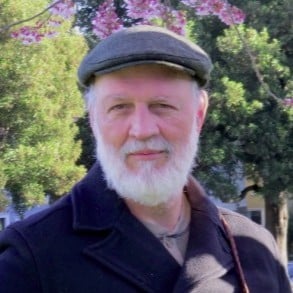
Jeff Kazor founded his groundbreaking and international influential band, the Crooked Jades, in San Francisco in 1994, recording nine albums and touring the US and Europe. A producer, musicologist and composer, Jeff is also a multi-instrumental magnetic vocalist and performer. He created the soundtrack to the award-winning PBS film “Seven Sisters” (2000) and produced music selected by Sean Penn for the film “Into the Wild” (2007). Kazor co-founded the grassroots San Francisco Bluegrass & Old-Time Festival in 1999.
Dave: Hi Jeff, what is your personal connection to this music?
Jeff: My family connection to old-time music was from my dad’s harmonica playing. He was the son of Polish immigrants who arrived in Canada during World War ll. He grew up in a farm in the prairie province of Saskatchewan. Saturday nights brought the legendary Wheeling Jamboree, a country music variety show out of West Virginia that carried over much of the continent on WWVA’s powerful radio signal.
Dave: Cool, so the WWVA signal made it up north then?
Jeff: Yes, the Jamboree also broadcast square dance tunes, and that’s where my father learned Anglo-American fiddle tunes on the harmonica, alongside old-world folk melodies he gleaned from his parents. I remember when I was about nine years old I would try to back him up on the guitar, and one of my favorite tunes I would always ask him to play was Money Musk.
Dave: What instruments do you play now?
Jeff: Guitar, harmonium, tenor ukulele, and Vietnamese jaw harp.
Dave: Tell us about your first instrument.
Jeff: My dad passed on to me his 1970 Yamaha FG 180 Nippon Gakki Red Label acoustic guitar.
Dave: Interesting, first instruments often are not keepers.
Jeff: The intonation on that instrument is the best of all my guitars, and the action on the neck is still true after all these years. Although I record with my other guitars, I usually write my songs on the Yamaha and take this rock-solid guitar to outdoor festivals.
Dave: What other musical influences did you have growing up?
Jeff: Besides my father and his harmonica tunes, my education continued through my family’s record collection. This included everything from the Stanley Brothers to Hank Williams and the Cajun music of the Balfa Brothers to the sad country tunes of George Jones, but what proved to be my biggest influence was the Folkways album The Watson Family. Its essence was a primitive mountain music sound that appealed to me because it couldn’t really be categorized. It was all over the map and blurred the edges between genres. This was the genesis that formed the foundation of the Crooked Jades.
Dave: When did you start exploring other sounds?
Jeff: When I was in college, I found myself immersed in the alternative-music scene, but after a while I realized that old-time music was more alternative than anything I was listening to on college radio. I decided I wanted to start a band and turn other people on to it, especially folks my own age.
Dave: How do you approach a new song or tune?
Jeff: When I compose my original music I tend to have the melody in my head first and then come up with the lyrics. My creative new arrangements of traditional tunes come from deep listening across genres that I’ve done over the years, from traditional Americana to post-punk German wave to South East Asian Java street bands.
Dave: Are there any other styles that you explore?
Jeff: I’m an old-school DJ spinning vinyl records several different nights a month, including an alternative ‘80s show, a funk, soul and disco night, and Frigo International discotheque, which is international dance music from all over the world spanning the 1930s through the 1970s. I continue to gravitate to international inspirations, including use of the harmonium, the Vietnamese jaw harp, and the Southeast Asian bao.
Dave: So you connect to international styles.
Jeff: Definitely, I find myself going across continents and going further and further back, seeing all these influences, melting pots that happen through time. I’ve been listening to old, old recordings from the Secret Museum of Mankind series, wax cylinder and wire collections, a lot of Middle Eastern, Asian and African music, and you can’t believe how close it is to some Anglo fiddle tunes. And obviously the banjo comes originally from West Africa.
Dave: Can you describe the Southeast Asian Bao?
Jeff: On a trip to Vietnam I picked up a one-string zither [the bao]. It was like the pedal steel guitar of the Orient, or the one string dobro of Southeast Asia. I knew I had to figure out some way to incorporate it into our music. So on the Shinning Darkness album we figured out a way to add it discreetly. It was a bear to play though! The dan bao’s estimated origin is over 500 years ago and the technique requires a great deal of precision. You use your fifth finger of your right hand resting lightly on the string and the other hand plucks the string. Then the right hand finds the harmonics positions to perform the melody. The really cool part of the instrument is the flexible vertical rod that you can push away from the instrument to pitch the notes higher and towards to lower the pitch or you can just use it as a whammy bar to add vibrato to any note.
Dave: What interests you when you are not playing music?
Jeff: I enjoy curating and collecting music from all over the world. I have a vinyl collection that’s in the thousands and continues to inspire me musically. My college degree is from San Francisco State University in film, and I love watching movies, especially silent film, science fiction and film noir.
Dave: What upcoming shows are looking forward to?
Jeff: I’m so excited to announce that the Crooked Jades and choreographer Kate Weare will be re-staging Bright Land at ODC in 2019.
Dave: You’ve work in Dance before as I recall.
Jeff: Yes and this is unprecedented modern dance/old-time music collaboration. The Jades and New York-based Weare first made a connection when the choreographer caught one of our shows at Café Du Nord in San Francisco while she was on tour. I have to admit; at first it’s a strange pairing. But Kate and I share a fascination with the ritual around old-time string band music, how it emerged and how it was a staple during the 1920s in rural mountain communities for social gatherings and worship – songs that reflect the hard times and make them go by easier with song and dance.
Dave: What eras of American music are your favorite?
Jeff: The dark-blurred and hypnotic sound of pre-radio is the era that I’m particularly drawn to, from the late 1800s up to 1926, just before the Bristol sessions and the invention of radio. Radio and the ability to record musicians started categorization of music into genres for mass consumption and homogenized much of what I find to be beautiful, strange and unique.
Dave: It’s interesting how Radio changed the music.
Jeff: Right, before radio and recording devices there was much more diversity. In certain regions of Virginia within a hundred mile radius, for instance, you could come up on three different styles of fiddling and clawhammer banjo playing. More isolation existed before radio and recording, and across the board there was just more blur, more swerve, more shadow, and more odd time-signatures.
Dave: What southern Appalachian styles or regions grab you?
Jeff: OH Boy! There are so many hidden pockets and cracks in American music during the turn of the last century and the sad part is very little of it was documented especially the black string band tradition. But as much as I love to listening to Tommy Jarrell and the amazing syncopation between Fred Cockerham and Oscar Jenkins from Mount Airy Region, North Carolina, I find myself digging deeper in the old weird America, going across to Arkansas in the remote Ozarks Mountains with the amazing rhythm section featuring the reed organ and the percussive fiddle sticks in the Reaves White County Ramblers (Drunkard’s Hiccoughs) and also another band that had a similar kinship first reported to be from the Ozarks, The Weems String Band who were actually from Perry County, Tennessee. The band’s unusual style featured ultra-staccato phrasing and highly creative melodic variations usually led by two fiddles with two finger banjo and more uniquely a chugging cello (Greenback Dollar).
Dave: Are there any other states or regions you have studied?
Jeff: Yes, the rich heritage of the Magnolia state, the more obscure fiddle band traditions of Mississippi that interestingly enough did not include the banjo in their instrumentation: Narmour & Smith, Nations Brothers, Leak County Revelers and the wild and primitive fiddling of Floyd Ming and His Pep-Steppers. Their version of Indian War Whoop is an energetic up-tempo crooked tune (odd number of measures) featuring the rhythm of stomping feet and the tradition of vocal whooping in sync with the fiddle.
Dave: What are some of your favorite fiddle tunes?
Jeff: Sally Johnson – Lewis Brothers, Girl Slipped Down – D. Dix Hollis, White Face – Joe Thrift (Red Hots), Indian War Whoop – Hoyt Ming and his Pep Steppers, Tie Your Dog Sally Gal – Will Adam, and Rye Straw – Ace Weems and the Fat Meat Boys.
Dave: What CBA events have you played?
Jeff: I played the main stage Fathers Day Festival in 2001 and 2003 and Vern’s stage in 2015 with the Cooked Jades. I had a GREAT time!
Dave: The Jades are playing the Father’s Day Festival this year, is there anything special planned?
Jeff: We are really looking forward to be performing on the main stage as a California Showcase Band and are super excited to be reunited with our amazing bass player Megan Adie. She is back from living in Europe and playing 17th and 18th century double bass. Megan has been an integral part of the Crooked Jades evolution. She has toured and recorded with the Jades for several years and played on several albums including her iconic arco bass playing on Worlds on Fire. Since the Jades will be playing as our full quintet, look out for some exciting new material and songs and tunes we haven’t played for over a decade.
Dave: What instrument makes and models do you have?
Jeff: My tour guitars: 1952 Gibson LG -2 and 1938 Kalamazoo Sport. Both guitars are fitted with internal condenser mics and pick-ups in the saddle. I can blend between the two sources with my D-Tar Solstice blender pre amp mixer. This set up gives me more flexibility in venues with challenging sound support.
Dave: Thanks for your time Jeff and looking forward to seeing you at Grass Valley.
Jeff: Thanks for this opportunity Dave.