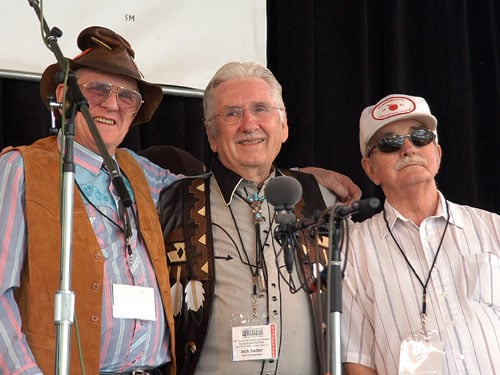
Jack Saddler (center) with fellow CBA co-founders Carl Pagter (left) and Jake Quesenberry at the 2005 Father’s Day Festival – CBA File Photo
by CBA’s Bluegrass Breakdown
Jack Sadler, one of the three founders of the California Bluegrass Association and a seminal figure in the beginning of the CBA, passed away Dec. 16, 2025, one day after his 96th birthday.
Born December 15, 1929 as Jackie Lee Sadler, Jack’s story is that of a teenage cotton picker and lumber mill worker who became a successful dentist, musician, songwriter, recording artist, yodeling champion, bow maker, airplane builder, squadron flyer, and a husband and father of three children, six grandchildren and two great grandchildren.
He was surrounded by music from an early age. His parents, born to sharecroppers, were living in Castle, Oklahoma, when they heard that California was full of riches with streets paved in gold. In 1936, his family drove down Route 66 to Tranquility, about 30 miles west of Fresno, where cotton was a major industry. Jack’s father worked at a cotton gin and Jack, his brother, and his mother picked cotton. When the cotton-picking season was over, he picked peaches in Modesto. Jack did not like the hot and sweaty job that paid almost nothing and felt there must be a better way to make a living.
He graduated from high school in 1947 and, at 18, he struck out on his own and moved to Chester to work at the Collins Pines Lumber Mill.
One memorable day as Jack was leaving a pool hall where mill workers often went after work, he saw the prettiest girl he’d ever seen walking across the street. It was love at first sight. Three weeks later, Jack and Janet Abildgaard eloped and married on June 11, 1950. They were married for over 70 years and had two sons, a daughter, six grandchildren, and two great grandchildren. Janet passed away on June 3, 2022.
Inspired by Janet’s brother in-law, who was a dentist, Jack and Janet moved to San Francisco where he attended dental school at the UCSF School of Dentistry. Jack graduated with a doctorate in dental surgery in 1959, and they moved back to San Jose to start his dental practice.
During his early years in California, Jack dabbled with guitar and mandolin. At 13, he bought his first fiddle. In 1943, his family moved to Ceres, where he attended high school and joined the marching band, playing primarily the baritone horn—a brass instrument that looks like a small tuba. He also played French horn and trumpet. Jack enjoyed listening to country music on the radio, and Hank Williams was his favorite. He was especially fond of the harmonies sung by bluegrass bands and the Sons of the Pioneers.
The start of Jack’s dental practice coincided with the start of the folk music boom of the 1960s. It inspired him to learn the five-string banjo and fiddle. In the early 1970s, he and Ron White formed the Overlook Mountain Boys, a bluegrass group named after the road he and Janet lived on in Los Gatos. The OMB played at private parties, fiddle contests, other casual events, and festivals including CBA’s. They continued to perform until the mid-1990s. The original OMB band included Jack on banjo, Ron White on Dobro, John Lytle on guitar, Dave Carlson on bass, and Arthur Kee on fiddle. When Arthur left the band, Jack Tuttle became the fiddler, followed by Joe Weed on fiddle and mandolin. Other performers at various times included Dale Johnson on mandolin, Tom Baker on mandolin, and Joe Kimbro on mandolin and guitar.
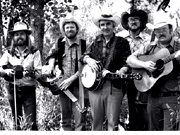 The Overlook Mountain Boys c. 1973
Over several years in the early 1970s, Jack hosted the legendary “Chicken and Pickin’” parties that were the biggest music jams in the area at that time. Jack once recalled, “I invited all my musical friends and I told them to bring their musical friends, and the first one was … boy! People all over the place!” The parties got bigger each time, until finally KTAO’s Al Knoth announced on-air that after his broadcast slot he was headed to Jack’s for chicken and pickin’. That one wasn’t just big; it was epic. “The cars were parked all the way from here down to the end of [Overlook Road]. In places I think they parked in some people’s driveways, too. And the police came, and the fire department came up, too.” It was those parties that Jack, Jake Quesenberry, and Carl Pagter met and discussed the formation of a bluegrass association. Carl, Jake, and Jack would become CBA members No. 1, 2, and 3, respectively, and were honored with lifetime CBA memberships. In 2008, Jack and Carl were also honored with lifetime achievement awards by the Northern California Bluegrass Society.
Jack was at the very first meeting of the Santa Clara Valley Fiddlers Association at a jam in March 1973, hosted by founder Bill Wein after he had moved to San Jose from Vermont. Bill loved fiddling and he missed his former fiddle club so much that he decided to start one in his new hometown. Jack suggested to Bill that it would be easier to join the California State Old-Time Fiddlers Association than to start one of his own, but Bill wanted his own independent organization to be run with his own vision. Jack became charter member No. 5.
Jack was also a bow maker. He applied the same care and skill that he learned as a dentist to making five bows, each with delicate inlaid frogs decorated with abalone and mother of pearl, and with windings of gold and silver. His teacher was his friend Jack English, a well-known bow maker.
Jack was also a plane builder and pilot. In 1975, Jack bought a wrecked WWII U.S. Navy Stearman biplane that once served in WWII, then became a crop duster, and finally became a pile of parts after it crashed. It took Jack 7 1/2 years to rebuild it, and he enjoyed giving rides to friends and family. The Watsonville airport still displays a painting of Jack in his biplane.
After 31 years as a successful dentist, Jack retired in 1990 and was able to devote more time to music. In 1993, he and friends Joe Kimbro and Paul King began to work on vocal trios in the Western style of the Sons of the Pioneers. In 1994, Lone Prairie became a formal band with Jack on harmony vocals and second fiddle, Joe Kimbro on lead guitar, Paul King on rhythm guitar, Ed Neff on lead fiddle, Karen Quick on bass, and Barbara Ann Barnett on accordion. Their first CD, Desert Flower, was recorded in 1996 and named after the love song Jack wrote for Janet. Both the title song and the album were nominated as best of the year by the Western Music Association. Their second CD, Back on the Dusty Trail was recorded in 2007. In 1999, Jack became WMA’s yodeling champion by performing “Yodelin’ Crazy.” Lone Prairie continued to perform through 2010.
In his later years, Jack continued to attend CBA festivals and SCVFA jams, singing harmony and playing second fiddle alongside his longtime friend Arthur Kee. The Overlook Mountain Boys and Lone Prairie had a reunion show in 2014 in San Jose.
Thanks to Jack’s granddaughter Natalie Sadler for sharing the news of Jack’s passing. Her cousin, Jack’s grandson Will Gemo, wrote, “Jack lived an amazing and inspiring life, showing that no matter what circumstances you are dealt with, you can still live the life you dream of.”
Jack will be dearly missed by his family and the CBA community.
Thanks to Richard Brooks, past-president of the Santa Clara Valley Fiddlers Association, whose 2014 profile of Jack for their newsletter, The Fiddler’s Rag, was excerpted in the August 2014 Bluegrass Breakdown, and served as the basis of this tribute.