
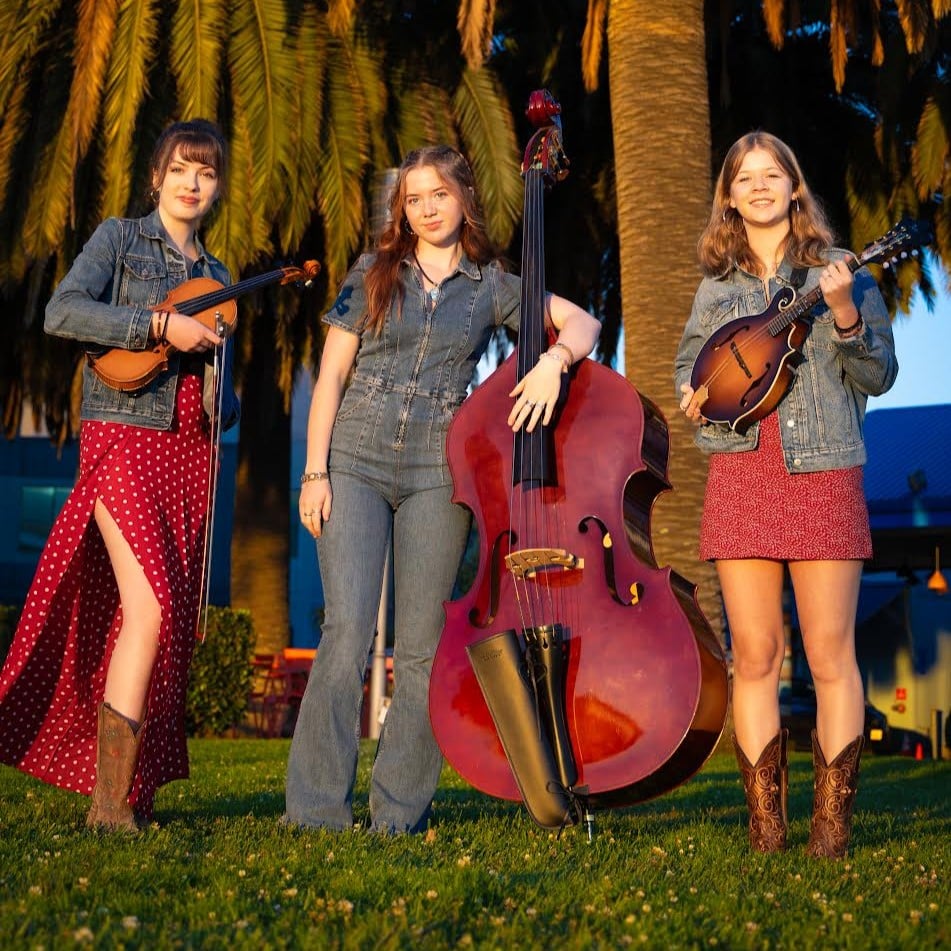
By Jason Dilg, Bluegrass Breakdown Managing Editor
We profiled our Father’s Day Festival openers Sweet Sally in the June issue of the Bluegrass Breakdown. The musicianship of each of its young members has been turning heads for a few festival seasons already. You can see the full text of their interview responses for our story here!
You all come out of a strong Bay Area youth music culture. What were the most important scenes, programs, teachers, jams, or school experiences in shaping you as musicians?
Lucy Khadder, fiddle and vocals: Some of the most formative experiences for me have been the CBA Youth Academy at Father’s Day Festival, Oaktown Jazz, and the Oakland School for the Arts Instrumental Program. Teachers and mentors like Chad Manning, Mads Tolling, and Alex Hargreaves have been hugely influential in shaping the way I play and think about music. I’ve also grown so much through camps like Big Sur Fiddle Camp and Shasta Music Camp, where I got to immerse myself in music and connect with other young players.
Sophia Sparks, mandolin and vocals: I started taking mandolin lessons with Sharon Gilchrist at Manning Music in Berkeley when I was about 8 years old. This is where I really think I got my fundamentals and roots, and where it all really began for me. Through the Manning Music community, I was able to meet a lot of talented people, one being my bandmate Lucy, and others who I still play music with today. Not only did I get such a strong start there, but it was the people at Manning Music who also originally connected me to events such as the Father’s Day Bluegrass Festival in Grass Valley, and the International Bluegrass Music Association’s annual convention, now in Chattanooga, Tennessee, and the larger CBA community. The Father’s Day Festival is what I’d consider my first experience with real jamming and just getting to know a whole slew of people in the CBA. I also did the Kids on Bluegrass program there when I was about 11, and met a lot of valuable friends there whom I also still play with today. I also attended the Kids on Bluegrass program at IBMA.
Clare O’Grady, bass and vocals: Oaktown Jazz Workshops and our high school, Oakland School for the Arts, were definitely some of the most impactful programs we participated in. These programs brought us lots of experience with playing professional gigs and forming our performance etiquette as well as helping us work on technical skills and playing many different variations of music.
What does Claire add, as the original duo has become a trio?
Lucy: Clare brings groove, pocket, and a low-end backbone that really grounds the higher instruments in our sound. She also sings and adds baritone harmonies that complete the picture of what we’re going for as a trio.
Sophia: I met Clare a few years ago at a jazz program in Oakland called Oaktown Jazz. She was a jazz bass player who we had heard had just started not that long ago, but was already sounding really good. Lucy and I wanted to expand the trio, and our top priority was to find a bassist, so Clare was kind of perfect. We kind of got her into the whole bluegrass scene, and she really adds a lot to the group now, not just being a bassist, but also a singer and just overall a really good bandmate.
Clare: The bass is an essential part of our sound as it lays a foundation for Sophia and Lucy’s improvisational ideas and backing for vocal songs. The bass helps ground the music and fill out a fuller sound, as well as adding another factor in the arrangement of pieces. In addition to playing bass, I also fill out lower harmonies in most of our music and lead many songs in our live shows.
What inspirations do you draw from in your arrangements?
Lucy: We all play jazz and love finding ways to incorporate it into our sound. Beyond that, we draw a lot of arrangement ideas from some of our favorite bands and artists, including Hawktail, Crooked Still, Sierra Hull, and I’m With Her. Studying at the Oakland School for the Arts and now at the Berklee College of Music has exposed me to so much music beyond bluegrass, and all of it finds its way into how we think about putting a song together. My two ensembles at Berklee this spring explored compositions by Tony Rice and Pat Metheny, and I also had a cool class called “Spirituals and Black Folk Traditions” that was part of the roots music program. I think we all love figuring out how to incorporate a variety of influences into our bluegrass roots.
Sophia: Yes, I would say we’re all inspired by other genres when it comes to composing and arranging. Being exposed to jazz starting in my freshman year of high school was really eye-opening and definitely very inspiring. I guess you’d find that our arrangements are not standard bluegrass, and there are definitely a lot of jazz components within them, such as groove choices and chord progressions. This just keeps us more inspired— although we all appreciate bluegrass being in our roots, it’s more interesting to both us and, I’d say, to our audience to go beyond bluegrass and incorporate the sounds of other genres such as jazz, folk, singer/songwriter, country, etc.
When you arrange a song, what are you usually chasing first: groove, harmony, feel, instrumental interplay, or something harder to name?
Lucy: We tend to arrange as we go, usually starting with a simple form and then building from there—adding rhythmic variation, instrumental interplay, or dynamic shifts as the song starts to take shape and we decide what it needs.
Sophia: I wouldn’t say there’s one way we always choose to arrange our material; it usually comes pretty naturally after playing the song a couple of times, and we generally just go with what feels the best to play. There are times when someone has a certain sound in mind that they were going for, so then we’d try to incorporate that. For example, if we want it to sound more jazzy, we might add a more swingy/groovy feel, as opposed to if we just want that hard-driving bluegrass root-5th feel, or something like that.
A lot of Bluegrass Breakdown readers have watched younger musicians come up through the California scene for years. From your side of it, what has it felt like to grow up in this music?
Lucy: Growing up in this music has felt incredibly supportive and fun. We were always just trying to sound like our inspirations while slowly finding our own style and voice along the way, and the music community around us was always very encouraging.
Sophia: For me, I always talk about the community of this music, because that’s what essentially brought me here. If it weren’t for the warm, welcoming bluegrass community, I definitely would not be where I am musically at all. With that being said, I have grown up surrounded by this music, going to music festivals that my mom used to produce, or just listening to CDs in the car that my dad bought. No matter where my music career goes or doesn’t go, my heart will always be closest to bluegrass and Americana music.
Do you feel any pressure, fair or unfair, when people hear a young band and immediately start talking about “the future of bluegrass”?
Lucy: We think of it as a healthy kind of pressure—a motivation to always strive to do our best, whether the music fits neatly into the bluegrass category or not. Bluegrass will always be a deep influence in our playing and writing, even when what we’re doing doesn’t exactly fit the stereotype, and we’re okay with that.
Sophia: I’m not sure if I’ve ever thought about it in that way, or have necessarily felt a huge amount of pressure, in that sense. Maybe there could be some sort of pressure in the way that they expect us to be the future of bluegrass in their eyes, which may not necessarily be how we see ourselves as a band. All we’re trying to do is make thoughtful music that we love and appreciate, whether it be bluegrass or not. I guess when people say that it’s always just a compliment, I don’t think about it too much, all I think is “Oh, yay! They think we sound good enough to be the future,” or something like that.
Clare: The three of us feel so much excitement and enthusiasm for the ideas being explored in this genre that a feeling of pressure doesn’t tend to weigh on us. We feel so grateful and honored to have any amount of involvement or impact on the legacy of this music, and are thrilled to see where these new ideas take us as a band and as a piece of the bluegrass collective scene.
What have you learned about being a band—not just a collection of strong musicians — that took some time to figure out?
Lucy: One of the biggest things we’ve learned is that everyone has something special to contribute, and it sometimes takes time to discover the best ways to bring those contributions together. We’ve also learned that making music with other people is what makes it truly fun—it inspires you in ways you never could have imagined on your own, both as a person and as a musician.
Sophia: Playing music with other people is a very vulnerable thing, which in my case—and, I would say, in a lot of musicians’ cases—has made my bandmates my best friends. Playing music successfully with someone means you need to know them musically and personally. That’s why getting thrown in a room with other spectacular musicians may not necessarily produce the most amazing output if they don’t know or listen to each other musically. Being able to intensely listen and interact with your bandmates is what makes a successful band. Also, the ability to communicate ideas, thoughts, whatever with your band is very important. Trusting each other’s musical visions and instincts has more often than not produced very good music. So, in hindsight, there is a lot more that goes into being a successful band than just all being strong musicians.
Clare: Among the many things that we’ve discovered about being a band, our most formative discovery was the importance of friendship with each other and how impactful that is to our sound and energy as a performing group. Every band has a unique dynamic, and our energy as a best-friend trio echoes into our interactions on stage, instrumentally and otherwise.
You’ve already played major events and festivals. What does an appearance at Father’s Day Festival mean to you specifically?
Lucy: Playing Father’s Day Festival is always such an honor. It’s a place where I grew up jamming and got to meet so many of my favorite people in music, and the youth programs at Father’s Day have helped me grow as a musician in so many ways. But what means the most, honestly, is the other young players and musicians I have met at the festival. I hope I see them all again this year!
Sophia: It is honestly kind of surreal to play Father’s Day on the main stage. Although it’s not my first time, it’s just cool to be playing on that stage after growing up seeing some of my favorite bluegrass artists play there as well. It’s also an easy audience to play in front of, as everyone there is a huge bluegrass music fan, and will do nothing but listen and support you while you’re up there.
Clare: Our band values experience and fun so much that our favorite times together are often at festivals or music-community-related events where we can meet others and jam together. One of the most beautiful things about bluegrass as a genre is how social and community-oriented it is, and using our musical skills to get together and make music with others who speak this language is one of the most beautiful and meaningful things to us. Father’s Day gives us the opportunity to meet people who share this passion and dedication for music that we hold, and we’re super excited to experience and contribute to the scene.
For each of you, who are a few musicians or bands—inside bluegrass or outside it—who have shaped the way you think about sound, repertoire, or stage presence?
Lucy: Some of the artists who have most shaped how we think about sound, repertoire, and stage presence include Hawktail, Crooked Still, Sierra Hull, I’m With Her, Bella White, and Bela Fleck.
Sophia: As far as our sound, I think it’s infused with a lot of different artists, bluegrass and non-bluegrass. I would say I’m personally most inspired compositionally and instrumentally within bluegrass by artists such as Bela Fleck (especially his My Bluegrass Heart project, but the Flecktones albums also have some amazing compositions on them), Chris Thile, and Sierra Hull—both their tone and ability to write monster fiddle tunes and way beyond that. And The Goat Rodeo Sessions was a very eye-opening album for us instrumentally. All of those grooves, arrangements, and all of it are just [chef’s kiss]. As far as vocals and arrangements go, I’m really inspired by singer-songwriters such as Bella White, I’m with her, and Nickel Creek-type stuff.
Clare: Bella White is a strong influence for us as musicians and performers, as she represents a sect of new bluegrass/folk music that is very youthful and pulls together modern performance expression and sounds with a genre that is generally associated with an older generation.
What do you hope an older, tradition-minded festival audience hears in Sweet Sally that might surprise them?
Lucy: We hope they hear how deeply traditional bluegrass has shaped our sound—and that they can also hear us being open to new ideas drawn from jazz and folk. We want it to feel rooted and familiar while also being genuinely our own thing.
Sophia: I would say we’re usually a little bit different than most bluegrass bands, maybe for our sound. When we played in Canada, we got a lot of comments saying something around the lines of “you were the biggest surprise,” in a positive way—perhaps meaning we didn’t sound like what they expected, but that was OK.
Clare: The three of us are excited to make an impact on the younger generation of this kind of music, uplifting a value for live acoustic music that could be challenged by some forms of digital production and streaming that lack the beauty of live instrumentation. We seek to bring experimental musical ideas into our classic live acoustic sound.
Why “Sally?”
Lucy: There’s a version of “Sweet Sally Brown” recorded by Tom Rozum that we love, and we thought it would make a great band name. I think Ralph Stanley was the first to record the song that he wrote with Wandell Smith. Sophia and I actually named the band when we were around 12 years old and playing as a duo, and it stuck.
Sophia: We chose this band name kind of inspired by some other all-women bluegrass groups such as Sister Sadie and Della Mae. There’s a bluegrass song called “Sweet Sally Brown,” and we basically just named our band after that song because we thought it had a nice ring to it.
What music are you listening to on repeat?
Lucy: Lately I’ve been listening to a lot of Julian Lage, Mike Barnett, and the Punch Brothers—pretty much on repeat.
Sophia: I always listen to a huge variety of music when it comes to genres, but my current artists on repeat are Kacey Musgraves, Watchouse, Mk.gee, Bella White, John Mayer, and Tony Rice.