
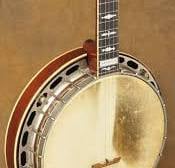
Most shoppers of authentic prewar Gibson Mastertone Banjos still face a dilemma: “this prewar Gibson is a nice archtop tenorbanjo, but to be useful for modern bluegrass it usually needs a flathead tone ring and always needs a five-string neck, preferably consistent in wood, shaping, and inlay selection with the original instrument.”* When Earl Scruggs purchased his 1930s Gibson banjos they would not have been useful to him had they not been original five string banjos with flathead tone rings (which Earl preferred over archtop tone). Back then it was nearly impossible to find an experienced craftsman to make a replacement five-string neck if the banjo was a tenor. But, by the early 1960s such neck makers had opened for business in several parts of the US, notably Los Angeles, Denver, and Nashville, all in response to the many new owners of prewar Gibson Mastertone tenor banjos. Several very talented neck makers still ply the trade across the US, and since some Gibson prewar Mastertone tenor banjos are still out there, good business for those craftsmen should continue for some time. “Blank” necks without inlay but somewhat fitted to 1930s rims are also available from some luthier suppliers at very much lower prices than custom necks. Completing such necks with fingerboard,peghead overlay, inlays, nut, professional-level finish work, lag bolts, and miscellaneous fittings can entail a lot of extra expense(and require that the work be completed by someone with significant lutherie experience and a very well-equipped shop), but still much less than for a custom neck.
Structural issues that can arise with prewar Gibson banjos include cracked or broken resonator flanges, upward-bent resonator flanges, outward bent tension hoops, missing metal parts such as brackets and tuning machines, and obvious post-production replacements such as resonators and metal parts(split banjo heads rank with broken strings as normal wear and tear, if less frequent). Resonator flange and tension hoop bowing and breakage problems usually arise from a combination of over-tensioned brackets and the relatively weak and fragile die-cast pot metal (“Zamak” or “zinc”) from which those parts were made after 1929. The flange is particularly vulnerablewhere the neck attachment system requires a deep cut into the flange. Tension hoops are usually simple to replace, but to find any resonator flange that fits a 1930s Gibson Mastertone banjowood rim is notoriously difficult—authentic prewar metal parts are incredibly rare, and Gibson produced at least three different dimensional versions of their resonator flange. A principal issue is that the coordinator rod action adjustment system tended to force the formerly round wood rim and resonator flange into an oval shape, so that over the years between prewar Mastertone banjo production and postwar bluegrass conversion only the original now oval flange will fit that now oval rim. Modern flanges may or may not fit prewar rims, with emphasis on “probably not.” Most prewar Mastertone owners who have that issue typically learn to live with it and take care not to let the problem worsen (pot metal parts cannot be brazed or welded). Prewar Gibson banjos can also be “counterfeited,” but such a practice is usually easily detected by anyone who knows what to look for in prewar Gibson Mastertone banjos. A slightly persuasive counterfeit might require that the counterfeiter scavenge at least some of the metal parts from an authentic prewar Gibson banjo—why would anyone do that? George Gruhn, the Nashville vintage instrument seller, aptly calls the characters that dependably identify an authentic Gibson Mastertone banjo “the distinctive marks of the maker,” whichrefers primarily to the distinctively Gibson shaping, fit, and finish of the components. Understanding the marks obviously requires that you examine many authentic instruments, but recognizing those marks becomes second nature before too long.
*Belated in this treatise is a description of the 1930-1941 Gibson Mastertone banjo style designations and specifications: Principal model designations: TB=tenor banjo; PB=plectrum banjo;RB=regular (five-string) banjo, plus several other model designations
Style 3: (“second generation” with one-piece resonator flange produced 1929-1937) The lowest and most common Mastertone model series, though original five string flathead instruments with certain inlay patterns are exceedingly rare. Almost all were archtops with a few flatheads produced on special order, neck and exterior resonator made of Honduras mahogany and mahogany veneer, metal parts nickel-plated, never engraved, a variety of inlay patterns, usually “Leaves and Bows” or “Hearts and Flowers.” After the Granada, the Style 3 and its 1937 successor the Style 75 are the most sought prewar Gibson Mastertone banjo—many players attribute the “prewar sound” to the mahogany wood selection and some even eschew the fancy maple Granada or walnut Style 4 in favor of the plain mahogany Style 3 (as though such a choice was commonplace). The Style 75 is discussed below.
Style 4: (second generation 1929-1937). Most were archtoptenors but original five string flathead instruments are known. Neck and resonator exterior were made from black walnut and black walnut veneer, metal parts were chrome plated, never engraved, and the inlay pattern was usually “Flying Eagle.” Butch Robbins purchased an original five-string flathead Style 4 in the mid 1970’s for what was then a record price paid for any prewar Gibson Mastertone banjo—see the Jim Mills “Gibson Mastertone Banjos” reference in the “sources” section for details.
Granada: (second generation 1929-1937). This is the “holy grail” of prewar original five string flathead Gibson Banjos, largely because Earl Scruggs, Don Reno, and Sonny Osborne played them, and because they are quite scarce overall; only a few original five-string flathead Granadas are known to exist. The neck and exterior resonator were made from figured mapleand figured maple veneer, metal parts were brush-gold-plated,with armrest, tension hoop, and tailpiece engraved. The distinctive Gibson “Flying Eagle” inlay was most common but “Hearts and Flowers” inlays are also known. Any authenticated original five string flathead Granada would be the most expensive bluegrass banjo, bar none (but see the notes about the “All American” and the RB-75 below).
Style 6, Florentine, and All-American—These were top of the line 1930s Gibson Mastertone banjos, with amazing decoration—ivoroid, gold sparkle, or checkerboard binding, gold plated engraved metal parts, rhinestones, and, in the Florentine and All-American models, elaborate painted resonator, neck heel, and reverse peghead surface wood carvings. In addition, the All-American peghead front face featured a painted eagle carving. These three models were discontinued in 1937 along with the rest of the 1930-1937 Gibson Mastertone banjo line. As fancy as they are and as expensive as these were at the time, original five-string Florentines with two-piece resonator flanges (1927-1930) typically command less in the current prewar Gibson Mastertone market nowadays than would an original plain five-string flathead Style 3 (1929-1937+ RB-75) because Florentines before 1931usually lack the revered combination of one-piece resonator flange, thin wood rim skirt, pot metal die-cast structural metal parts, and double-cut peghead shape (I have seen 1930s “conversion” Florentines with one-piece resonator flanges which should but still do not make them rival original flathead five string 1930s Gibsons in value). Nevertheless, they are rare, fantastic banjos, always worth a long look just to appreciate Gibson’s capabilities even in that Depression Era. Note—what is purported to be the one and only original five string Gibson All American banjo has recently been offered for sale for about $250,000. This putative 1931 banjo has a “cut” Mastertone label inside the wood rim, which may indicate conversion from a factory archtop tone ring to a flathead tone ring (but cut labels vary quite a lot and do not always indicate such a conversion). It also includes the desirable one-piece pot-metal resonator flange, gold plated and engraved. If it is indeed an authentic original five string flathead Gibson All-American banjo, its rarity certainly justifies a substantial price, and it will be interesting to see how long it stays on the market.
The Style -75 (produced 1938-1943) was essentially an “economy” version of the Style 3. The Top Tension series noted below, and the Style 75, replaced the entire earlier standard Gibson Mastertone banjo line, which Gibson dropped in 1937when high-end tenor banjo sales were flagging. Style 75 appointments were purportedly identical to the Style 3 but the “standard” (see the note below about what constituted Gibson “standard”) inlay pattern was somewhat simplified. Some RB-75s included elaborate Flying Eagle inlay patterns, unusual for an “economy” instrument. These high-end fingerboards are thought to be from inlaid fingerboards left over from discontinued high-end banjos (Syles 4 and Granada) from 1930 through 1937. From 1990 onward, J. D. Crowe used an original five string flathead 1938 RB-75, and he shared the banjo design, appointments, and other details with Gibson some years later so that Gibson could re-create and market J. D. Crowe’s RB-75copies (marketed by Gibson as “The Blackjack”). The “Blackjack” RB-75 included a flathead tone ring that produced noticeably different tone than did Crowe’s original flathead RB-75, as Crowe asked. The new “Crowe/Blackjack” tone ring closely resembled the “Tennessee 20” tone ring which “First Quality Music Supply” (now Sullivan Banjos) produced. The Sullivan Tennessee 20 tone ring differed somewhat in dimensions and mass from the original Gibson flathead, and ithas earned considerable respect in the banjo world.
In 1937 the Style 75 designation was Gibson’s first foray into its new pricing model— “75” referred to the retail price of the model, so that the Style 75 retailed in all configurations for $75. That pricing model for most Gibson banjos continued into the early 1960s. Nowadays, an original flathead five string Style 75 ranks with the original flathead five string 1930s Gibson Granada as the first (Granada) and second (RB-75) most valuable and expensive bluegrass banjos.
Styles 7, 12, 18, the “Top Tension” series, introduced in 1938, discontinued with most banjo production in 1941, made somewhat popular among modern bluegrass players because Bill Keith and Noam Pikelny have played one model or another (plus other top tension banjos from other sources). The three Styles differ in wood selection and metal plating and engraving appointments, but all shared an entirely new face-mountedbracket tensioning system. The brackets and thus the head tension were adjustable from the face of the banjo withoutrequiring resonator removal to access the adjusting nuts. The tension hoop was nearly indescribable, a massive circle of metal with an outward extension for each of the 24 newly designed brackets, and the resonators were lathe-turned rather than laminated—the combination of significantly more metal and the thicker resonator made the top tension series the heaviest ever of the Gibson banjos. The fingerboards were typically arched side-to-side like acoustic guitar fingerboards, but the source of inspiration for that design is not clear. Overall, these banjos are uncommon in the prewar Gibson Mastertone market, but most sported factory original flathead tone rings and some original five-string top tension banjos exist. For players with good health insurance and orthopedics clinic access, these were nearly ideal banjos, even though they sound quite different than the earlier Styles 3, 4, Granada, and 75. I can affirm that they sound great, at least on average, and are best played sitting down.
Other specifications: prewar Gibson banjos had Brazilian rosewood fingerboards, except for the Style 6 which had ebony. Peghead overlays were typically some kind of laminated wood and fiber or not at all—non-Mastertone prewar banjos peghead faces were finished with black paint, postwar “Bowtie” banjos pegheads were typically sprayed with high gloss nitrocellulose lacquer and inlaid with mother of pearl into that surface. After 1983 Gibson Mastertone banjo pegheads are seemingly overlainwith what seems to be a hardwood black-stained laminate. Some custom neck makers still use ebony for fingerboard and peghead overlay—that wood is nice looking and somewhat stronger, but it is not authentic on most prewar Gibson Mastertone banjos. These days Brazilian rosewood is rare andexpensive, and adding that wood to a neck commission would increase the price often by $300–$500. Non-Mastertone banjos typically had one neck attachment coordinator rod and one hex nut, while Mastertone level banjos are said always to have had two coordinator rods (1927-1943, 1954 onward)—I have seen many banjos for which that specification was simply untrue. Tailpieces varied across the spectrum of availability but most common in the lower end were the “Presto” tailpieces, whoseadjustability is just a fantasy. Nevertheless, an original prewar Presto tailpiece can command quite a considerable sum in today’s market. Any of the tailpieces that were supplied with Gibson Mastertone tenor or plectrum banjos had provision for mounting just four strings, and when the pot is changed to support five strings some provision must be made to mount the fifth in the tailpiece. The simplest approach is to mount a new tailpiece of the same design with the correct plating and provision for five strings, and to put the original tailpiece aside and never lose it. Otherwise, the original tailpiece must be drilled to accept the fifth string, assuming the design is amenable. I would consult a banjo luthier who has experience with this problem before drilling or otherwise altering the original tailpiece.
Caveat: I have provided seemingly precise and authoritativedescriptions of the Gibson Mastertone styles above, but Gibson never felt the same need to adhere strictly or even loosely to any catalogue description of any of its bolt-together instruments (i.e., banjos). They often just used whatever wood or parts or resonators were available or in surplus that day, or they quite often filled special orders that diverged from catalogue descriptions, even including widely different scale lengths and fret numbers, but whose provenance is now often lost. Thus, you might encounter authentic instruments that deviate far from the descriptions I have provided, particularly in metal plating and inlay patterns. Never fear—that is normal for Gibson and all you can do is examine as many prewar Gibson Mastertones as you can to appreciate that spectrum. Where I have used the terms “never” or “always” in the above descriptions, their meanings are “not catalogued that way but this one has that feature” and “usually has that feature but might not on the banjo you’re examining.” Seeing how widely Gibson banjos can vary from their catalogue descriptions is all part of the fun.
So, why do original five string flathead Gibson Mastertone banjos sound so nice? First, we must agree that the premise is true. Data that support that conclusion are simply lackingbecause few players ever have the opportunity to play one of the celebrated icons, yet it is true that in my experience folks (including me) who have had the opportunity to play such banjos tend to agree that as a rule they sound great. We really must accept on faith that original five string flathead Gibson Mastertone banjos sound “great,” since so few (if any) players have called them the opposite. On the other hand, in the early 1970s I ran across a memorable “dud” original five string flathead RB-3 (maybe it just needed better setup), which suggests that like any such at least partially handmade object Gibson Mastertone banjos will not all be identical, and that once again, setup if not everything is almost everything. Really, I tried every trick I know to extract tone from that banjo but it was not to be. On the other hand, conversion Mastertone banjos can sound nearly as nice as original five-string flathead instruments, so do not think less of such instruments just because of what they are. The time is likely to come when conversions typicallysound just as nice as an all-original flathead Mastertone.
I will cite several, shall we say, unsupported ideas about the superior tone of these banjos, and then will offer my own opinion. A few of the myriad unsupported ideas include “Gibson lost the formula for the brass tone rings when World War II started” (they didn’t), the maple that Gibson used in its 1930s wood rims was superior (?) to that in modern banjos” (it isn’t), “the outer (mahogany or maple) lamination in prewar Gibson Mastertone resonators was better wood than used later” (it was not, and in any case the inner lamination, made from poplar then and forever at Gibson [Top Tension series excepted], would have more influence on tone than the exterior lamination ever would), “the gold plating on the (Granada) tone ring makes all the difference” (probably not), “the mahogany neck (on the Styles 3 and 75) makes all the difference” (maybe a tiny bit but not so you could tell), and “the tone ring crystallizes over time and that makes all the difference” (huh?). Component changes that can indeed produce tonal differences (note that “differences” is not the same as “improvements”) in Gibson Mastertone banjos include swapping the tailpiece for one of different design, trying various bridges ranging from $5.00 Grovers all the way to $35.00 Snuffy Smiths and similarly priced bridges, swapping banjo heads (a fraught endeavor but usually the most potent influence on banjo tone), taking the entire banjo apart and re-assembling it carefully (not for the faint of heart), and swapping out major wood and metal parts such as tension hoops, resonators, resonator flanges (good luck!), even wood rims and necks (the banjo you had is no longer that banjo).
